The recent news of the rioting, looting and destruction in Tonga's capital Nuku'alofa is quite sad. With eight deaths and the rebuilding cost already estimated at $75 million USD it's a heavy blow to the country. The healing process will no doubt take many years.
A short news story on the Radio New Zealand International website caught my eye this morning. Apparently some palagis have suggested that Samoa will be the next country in the region to "have the same troubles as Tonga". Samoan Prime Minister, Tuila’epa Sa’ilele Malielegaoi, responded by stating that "the strength of the Samoan cultural ties and the people’s respect for its traditional leaders and traditional avenues in resolving dispute will always prevail". But isn't all of this missing the mark?
Tonga is a constitutional monarchy and the Tongan monarchy plays a very strong role in the country's political process. The Tongan Cabinet currently consists of 14 members, 10 appointed by the monarch for life; 4 appointed from among the elected members of the Legislative Assembly, including 2 each from the nobles and peoples representatives serving three year terms. There are no elections; the prime minister and deputy prime minister are appointed by the monarchy.
For several years a strong pro-democracy movement has been growing in Tonga. It "emphasises reforms including better representation in the Parliament for the majority commoners, and better accountability in matters of state" (Wikipedia entry). Recently, a Constitutional Commission has been considering suggestions as to how Tonga's constitution might be reformed.
With the September succession to the throne by Siaosi Tupou V, it was believed by many that there would be advances in the reform process sooner rather than later. The rioting is said to have been triggered when it seemed that the parliament would adjourn for the year without having made any advances in increasing democracy in government.
By contrast, Samoa is a mix of parliamentary democracy and constitutional monarchy. The Samoan monarchy, generally speaking, plays little role in the political process. There are elections held every five years and the government has been very open to political, judicial and legislative reform, driven particularly by cooperative foreign aid/development projects.
In short, Samoans have democracy where Tongans do not. It's certainly not perfect and does have its fair share of problems but by and large it works. As such, Tuila’epa's comments about the strong ties within Samoan culture, the respect for traditional leaders and traditional disputation processes are valid but in my eyes don't really strike at the heart of the matter. Furthermore, as the legal challenges following the March 2005 elections illustrate (see here, here and here), there is a growing tension between the traditional power structures and the newer judicial and legislative structures. Since I left Samoa in September, I have heard of two more cases held in the Land & Titles Court challenging village rulings over banishments.
Nonetheless, I agree completely with Tuila'epa's refutation of the claim that Samoa will be the next Pacific nation to endure mass civil disobedience and rioting. I simply cannot imagine it happening. I hope Tonga can solve the problems it faces and wish the very best for my friends in Tonga and my friends elsewhere with family in Tonga.
Mau nofo a e.
Tuesday, November 21, 2006


Tuesday, October 24, 2006
Something a little off topic
I've just been watching Foreign Correspondent on Australia's ABC. It contained a story about the hazards of living with elephants in Sri Lanka. An elephant trainer interviewed for the story said, "There's no point to a country if it doesn't have elephants." I couldn't agree more.
Sunday, October 22, 2006
Water, water everywhere and not a drop to drink
It's an island nation in the middle of the Pacific Ocean yet Samoa has water supply problems. According to a recent news report from Radio New Zealand International, the Samoa Water Authority has publicly acknowledged that there is a problem, stating that low water levels at the major treatment plant in Fuluasou are to blame.
Of course this isn't news to anyone who's lived in villages like Vaitele, Vailele and Fagalii-uta (where I lived). Watching the water emanating from the taps turn from clear to milky white to murky brown then shortly after stop running at all was a fairly regular past time. I was fortunate enough to have a water tank that at least allowed for a few showers and cups of tea/coffee beyond what my neighbours typically enjoyed.
The water would most often run out during and after periods of heavy rain; soil blocking the pipes and all that kind of thing. This time around however the problem really is supply. The dry season has yet to run its course so there's not an awful lot of rainfall that would result in blocked pipes. Just before I left in mid September I drove past the major dam on 'Upolu and noted that it was almost entirely dry.
I've been told by a friend still in Fagalii that they've been without water for a while now. And whilst the rain isn't falling readily or steadily enough they're unable to catch much water in buckets and have "outdoor showers" as I was want to do. Their situation is a bit of a catch 22. No rain means no mains water; any big dump of rain is likely to lead to blocked pipes anyway. Bugger.
Of course this isn't news to anyone who's lived in villages like Vaitele, Vailele and Fagalii-uta (where I lived). Watching the water emanating from the taps turn from clear to milky white to murky brown then shortly after stop running at all was a fairly regular past time. I was fortunate enough to have a water tank that at least allowed for a few showers and cups of tea/coffee beyond what my neighbours typically enjoyed.
The water would most often run out during and after periods of heavy rain; soil blocking the pipes and all that kind of thing. This time around however the problem really is supply. The dry season has yet to run its course so there's not an awful lot of rainfall that would result in blocked pipes. Just before I left in mid September I drove past the major dam on 'Upolu and noted that it was almost entirely dry.
I've been told by a friend still in Fagalii that they've been without water for a while now. And whilst the rain isn't falling readily or steadily enough they're unable to catch much water in buckets and have "outdoor showers" as I was want to do. Their situation is a bit of a catch 22. No rain means no mains water; any big dump of rain is likely to lead to blocked pipes anyway. Bugger.
Sunday, October 15, 2006
Miss Teuila controversy
This year's Miss Teuila pageant has not been without a degree of controversy. Supporters of Miss Samoa, New Zealand, a contestant who was named second runner-up, were extremely vocal in their disappointment. In the few days prior to my departure from Samoa, their letters of complaint filled the pages of The Observer.
I believe that it was these supporters who discovered that Pearl McFall (Miss NUS), who was crowned Miss Teuila, was 17 at the time she registered in the pageant. Pageant rules dictate that contestants must be 18 years of age or older to enter. This news was, of course, picked up by the media and became the only story worth telling for a few days.
McFall officially relinquished her crown five days after being crowned Miss Teuila, holding a press conference at the National University of Samoa campus to make the announcement. This resulted in Poinsettia Taefu, the first runner-up, being crowned Miss Teuila 2006. Having cleaned up seven of the ten individual category awards (e.g. Best Talent, Best Puletasi, etc.), it seems fitting that Poinsettia wears the crown. Congratulations 'tia!
I believe that it was these supporters who discovered that Pearl McFall (Miss NUS), who was crowned Miss Teuila, was 17 at the time she registered in the pageant. Pageant rules dictate that contestants must be 18 years of age or older to enter. This news was, of course, picked up by the media and became the only story worth telling for a few days.
McFall officially relinquished her crown five days after being crowned Miss Teuila, holding a press conference at the National University of Samoa campus to make the announcement. This resulted in Poinsettia Taefu, the first runner-up, being crowned Miss Teuila 2006. Having cleaned up seven of the ten individual category awards (e.g. Best Talent, Best Puletasi, etc.), it seems fitting that Poinsettia wears the crown. Congratulations 'tia!
Tuesday, October 10, 2006
Fine with my wife
I've wanted to post more photos and write more about Samoa but unfortunately my computer is in for repair. This might take a few weeks, so my chances of posting are going to be slim. Nonetheless, I will endeavour to put something up in the next week or so.
In the meantime, for those of you with broadband (or similar) Internet connections, might I suggest you check out this video clip (YouTube) by the biggest musical group in Samoa, Zipso. It's the song "Fine With My Wife". Nothing beats a song with the chorus
In the meantime, for those of you with broadband (or similar) Internet connections, might I suggest you check out this video clip (YouTube) by the biggest musical group in Samoa, Zipso. It's the song "Fine With My Wife". Nothing beats a song with the chorus
She came and said, "Sole! Zipso. You and me. My house, let's go."Enjoy the clip. I hope to get some more tales and photos to you soon. Cheers.
"It's ok. It's alright. Girl, I'm fine, with my wife."
Sunday, October 01, 2006
Gone bananas!
Dear me. I'd heard about the price of bananas going through the roof in Australia thanks to Cyclone Larry early in the year but it didn't really mean anything until I saw this earlier today in downtown Melbourne:

Bloody hell! That's $34 WST (Tala) for a kilogram of bananas. I've seen numbers that suggest your average banana weighs about 100 grams. If that's the case, it's fair to say that Samoa is living the good banana life. Ten bananas will set you back no more than $3 or $4 WST at Fugalei markets.
Just to make life worse, a morning of extreme cold a week or so ago destroyed a significant portion of the stone fruit crops in Victoria. If the stratospheric prices for bananas weren't enough, it now looks like stone fruit like apricots, nectarines and plums will cost a fair amount this season too. Crisis!
Whilst much stone fruit isn't available in Samoa, send me back anyway please! Cheap, tasty bananas and mangoes that just fall off the trees everywhere you look. Count me in.

Bloody hell! That's $34 WST (Tala) for a kilogram of bananas. I've seen numbers that suggest your average banana weighs about 100 grams. If that's the case, it's fair to say that Samoa is living the good banana life. Ten bananas will set you back no more than $3 or $4 WST at Fugalei markets.
Just to make life worse, a morning of extreme cold a week or so ago destroyed a significant portion of the stone fruit crops in Victoria. If the stratospheric prices for bananas weren't enough, it now looks like stone fruit like apricots, nectarines and plums will cost a fair amount this season too. Crisis!
Whilst much stone fruit isn't available in Samoa, send me back anyway please! Cheap, tasty bananas and mangoes that just fall off the trees everywhere you look. Count me in.
Sunday, September 17, 2006
Tofa soifua
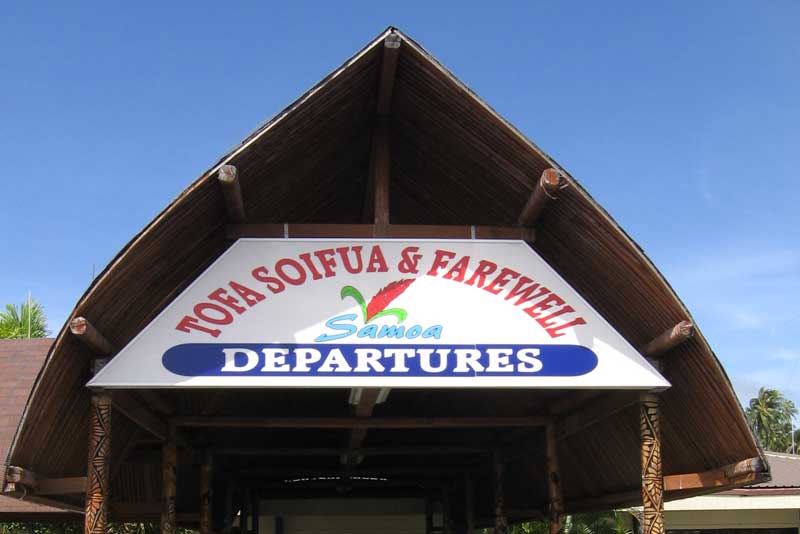 When you leave Samoa by air, the last thing you see before you enter the plane is this sign. Sadly for me, it was what I saw on Thursday. My assignment completed, it was time for me to say farewell and fly to Sydney.
It's been very tough saying goodbye. My time in Samoa has been incredible and I've been so fortunate to have worked with, and otherwise meet, so many wonderful people. Not to mention how beautiful a country Samoa is.
I know Sydney has its own beauty but at the moment, I'm having to work harder to find it. It smells funny, it feels far too busy, there is a cacophony of noises that are both familiar and strange and no one smiles as they walk down the street.
On the flipside, I've already had some amazing food; simple food that we too often take for granted. Incredible cheeses, good Chinese cuisine and, my highlight thus far, fresh strawberries.
Other than sheer exhaustion (sensory overload!) my main problem thus far would be accepting the reality of my situation. I keep referring to things, places and people in Samoa in an inclusive way. Next week our paddling club will start regular training nights (Monday, Tuesday and Thursday from 5pm if anyone's interested). We commence an interesting project at work this week.
In spite of the change of location, I'm hoping that it will continue to make some sense to talk about Samoa in such a way. I'll still be in touch with friends and I'll definitely be requesting the latest news and gossip that's doing the rounds of Apia.
If nothing else, I certainly have many more things I want to say about Samoa and my time there on this blog. And having taken close to six thousand photos, I'm sure I can find a few more to put online.
Wednesday, September 13, 2006
Teuila races
After the Miss Teuila pageant, the fautasi race is probably the most popular event of the Teuila festival. As in the Independence Day race, fautasi crews compete in a five kilometre races that starts at Faleula and ends in Apia harbour. Once again, two teams were the ones to beat. The Manono crew that won the Independence Day race and the Don Bosco crew that took top honours in American Samoa earlier in the year.
Unfortunately, I didn't watch the race live. Due to the reef and shallows, the race needs to be held in conjunction with high tide, so it started at 6am and I'm not much of a morning person. This didn't stop me from making a bet on the outcome with a colleague from my paddling club. We made a deal that if the Manono team won I would buy him a beer; if the Don Bosco boys took out the prize then he would buy me won. I'm happy to say that I'm now owed a beer. The Don Bosco team beat the Manono crew by a decent margin. I think it's a good thing. The Manono boys have won everything in sight for the last three or four years, so a changing of the guard is healthy.
 The fautasi race isn't the only race during the festival however. This year our paddling regatta was incorporated into the program. It was a great day and we had a fantastic turn out. We had nine teams in the social division and three clubs submitted teams for the more professional divisions.
We decided after the last regatta that we needed a uniform. You have to look the goods even if you're actually not that good at all. Thus, we decked ourselves out in matching tshirts and lavalavas. Alas, it didn't bring great results, but that doesn't matter. We had a good time of things. In the more senior divisions there were some fantastic races. The Pualele club edged out the Paddles club in the big races but had to fight hard for their wins. The 500m final for example saw less than a second separating the first two boats, with third place finishing less than two seconds behind them. Very exciting stuff.
Unfortunately, I didn't watch the race live. Due to the reef and shallows, the race needs to be held in conjunction with high tide, so it started at 6am and I'm not much of a morning person. This didn't stop me from making a bet on the outcome with a colleague from my paddling club. We made a deal that if the Manono team won I would buy him a beer; if the Don Bosco boys took out the prize then he would buy me won. I'm happy to say that I'm now owed a beer. The Don Bosco team beat the Manono crew by a decent margin. I think it's a good thing. The Manono boys have won everything in sight for the last three or four years, so a changing of the guard is healthy.
 The fautasi race isn't the only race during the festival however. This year our paddling regatta was incorporated into the program. It was a great day and we had a fantastic turn out. We had nine teams in the social division and three clubs submitted teams for the more professional divisions.
We decided after the last regatta that we needed a uniform. You have to look the goods even if you're actually not that good at all. Thus, we decked ourselves out in matching tshirts and lavalavas. Alas, it didn't bring great results, but that doesn't matter. We had a good time of things. In the more senior divisions there were some fantastic races. The Pualele club edged out the Paddles club in the big races but had to fight hard for their wins. The 500m final for example saw less than a second separating the first two boats, with third place finishing less than two seconds behind them. Very exciting stuff.
Teuila!
Teuila festival. It's the biggest event on the Samoan cultural and social calendar. It's a week long celebration of the fa'asamoa and is full of events aimed to attract Samoans and palagis alike. Fairy lights are strung up all along Beach Road, making Apia harbour look even more beautiful at night. Stalls are set up next to the Government building where people sell clothing, art, food and demonstrate traditional crafts such as tattooing and weaving.
The biggest event of the festival is of course, the Miss Teuila pageant. Eleven women from Samoa, New Zealand, Australia and the United States competed to win the illustrious title. The build up to the pageant is pretty big but the event itself is even bigger.
I watched the pageant live on television with some friends of mine. It turned out to be far better than going to the event itself (well, I think so anyway). My friends were caustic in their appraisal of the contestants' efforts, which was hilarious. Mind you, the girls don't do themselves many favours. The talent round was particularly awful, with only one girl really showing any considerable talent. The highlight however, was (as always) the interview round.
On the topic of what she would focus on if voted as Miss Teuila, contestant number 1 had to say that "fundraising for the old people so they have more days to live on earth" would be one of her priorities.
Contestant number 11 stated that, "as a strong believer that women can do anything, women can do anything."
Yet another contestant, when asked what the best things about Samoa's environment might be, simply responded, "The best thing about the environment of Samoa is its features." The pregnant pause that followed, and the laughter from the audience, eventually convinced her to think about her answer and elaborate somewhat.
Miss Samoa Australia, when pausing for breath at the end of one mindless statement, demanded that the audience wait: "Please, I haven't finished......just kidding". No. You weren't. And I'm beginning to wonder what on earth you were raving on about when you mentioned the chattels in all the other countries of the world, that clearly made Samoa the best place to be.
The comments of the evening came from the outgoing MissTeuila, who bemoaned the loss of title. No more free air travel and "free lunch will be a distant memory". She even begged the owner of a beauty salon in Apia for just one more full body workover. Still, she insisted that any tears shed by her on the night would be tears of joy, not sadness, and thus my friends and I took her at her word.
The winner on the night was Pearl McFall, this year's Miss NUS (National University of Samoa). A work colleague's daughter came second, although thanks to winning seven of the ten category prizes, I'm pretty certain she doesn't mind one bit. She has something like six or seven return flights to New Zealand, hotel accommodation, cash prizes, wine, manicures, massages, etc., to enjoy.
The biggest event of the festival is of course, the Miss Teuila pageant. Eleven women from Samoa, New Zealand, Australia and the United States competed to win the illustrious title. The build up to the pageant is pretty big but the event itself is even bigger.
I watched the pageant live on television with some friends of mine. It turned out to be far better than going to the event itself (well, I think so anyway). My friends were caustic in their appraisal of the contestants' efforts, which was hilarious. Mind you, the girls don't do themselves many favours. The talent round was particularly awful, with only one girl really showing any considerable talent. The highlight however, was (as always) the interview round.
On the topic of what she would focus on if voted as Miss Teuila, contestant number 1 had to say that "fundraising for the old people so they have more days to live on earth" would be one of her priorities.
Contestant number 11 stated that, "as a strong believer that women can do anything, women can do anything."
Yet another contestant, when asked what the best things about Samoa's environment might be, simply responded, "The best thing about the environment of Samoa is its features." The pregnant pause that followed, and the laughter from the audience, eventually convinced her to think about her answer and elaborate somewhat.
Miss Samoa Australia, when pausing for breath at the end of one mindless statement, demanded that the audience wait: "Please, I haven't finished...
The comments of the evening came from the outgoing MissTeuila, who bemoaned the loss of title. No more free air travel and "free lunch will be a distant memory". She even begged the owner of a beauty salon in Apia for just one more full body workover. Still, she insisted that any tears shed by her on the night would be tears of joy, not sadness, and thus my friends and I took her at her word.
The winner on the night was Pearl McFall, this year's Miss NUS (National University of Samoa). A work colleague's daughter came second, although thanks to winning seven of the ten category prizes, I'm pretty certain she doesn't mind one bit. She has something like six or seven return flights to New Zealand, hotel accommodation, cash prizes, wine, manicures, massages, etc., to enjoy.
Sunday, September 10, 2006
Followup on the follower of fashion
Early last week I had several of my clothes disappear from my clothes line. I discovered a few of them on the body of the village security guard. Hilarity ensued.
Later that week I was called over to my landlord's house (conveniently no more than 30 metres away) and I was formally presented with my clothing and an apology on behalf of the security guard, his family and the landlord's family. It was an interesting moment of fa'asamoa.
Anyway, the end result of all of this was that not only did I have confirmation that someone liked my clothing enough to pinch it off the line, I even had it returned. Fantastic!
Sadly, my dreams came crashing down this morning as I discovered that the security guard was in fact fairly critical of one item of clothing. Imagine my horror as I noticed that he'd "coughed his rompers". No. My rompers. Now imagine my horror at discovering this after I'd been wearing them for half a day!
That's one pair of shorts that won't be making the trip back to Australia with me.
Later that week I was called over to my landlord's house (conveniently no more than 30 metres away) and I was formally presented with my clothing and an apology on behalf of the security guard, his family and the landlord's family. It was an interesting moment of fa'asamoa.
Anyway, the end result of all of this was that not only did I have confirmation that someone liked my clothing enough to pinch it off the line, I even had it returned. Fantastic!
Sadly, my dreams came crashing down this morning as I discovered that the security guard was in fact fairly critical of one item of clothing. Imagine my horror as I noticed that he'd "coughed his rompers". No. My rompers. Now imagine my horror at discovering this after I'd been wearing them for half a day!
That's one pair of shorts that won't be making the trip back to Australia with me.
Wednesday, September 06, 2006
Isa, Sala and Te'a

Meet Isa, Sala and Te'a (l to r). They live on Namua. They're wonderful kids with infectious attitudes and brilliant smiles. Their family is similarly delightful. It's been an absolute pleasure getting to know them all over the last year.
Sunday, September 03, 2006
A small exercise in irony
Saturday's Observer contained a story and a letter to the editor, both of which caught my eye. The letter to the editor bemoaned the poor quality of the quiz show that has just started on local television:
I had to laugh.
The story, following on from the recent decision to shut the majority of the nightclubs in Apia for three months, focused on two tourists to Samoa who think that the shutdown order is great. Mr Backlet, in particular thinks it's great because
His travelling companion, Mr Coan, was in complete agreement, saying that Samoa is a wonderful country because Christian values are being upheld. Mr Backlet continued, warning Samoa against accepting foreign cultures and ideas. What? Like Christianity?
I agree that it is high time that such a competition should take place in Samoa. HOWEVER, the quality and the phrasing of the questions are very poor, very confusing and need considerable improvement.
But more importantly, there needs to be a proper evaluation that the answers are correct. A lot of the answers given by the quizmaster are WORNG!
I had to laugh.
The story, following on from the recent decision to shut the majority of the nightclubs in Apia for three months, focused on two tourists to Samoa who think that the shutdown order is great. Mr Backlet, in particular thinks it's great because
Despite the nightlub business being a fast money turner, only violence, corruption, prostitution, gambling, immoral sexual and gangster activities will happen as a result.
His travelling companion, Mr Coan, was in complete agreement, saying that Samoa is a wonderful country because Christian values are being upheld. Mr Backlet continued, warning Samoa against accepting foreign cultures and ideas. What? Like Christianity?
Wednesday, August 30, 2006
A dedicated follower of (my) fashion
A couple of days ago I noticed that some of my clothes were missing. Some shorts and maybe a t-shirt or two. Someone had taken them from my clothes line. It's not that big a deal; clothes can be easily replaced. I didn't think that much of it.
This morning, as I left for work in a taxi (I'd missed the bus), I saw the village security guard (all villages with government housing employ security guards) walking down the road in a nice t-shirt and what looked like a comfortable pair of shorts. My t-shirt and shorts. I had to say something.
 I asked the taxi driver (pictured here) to stop the car and I hopped out to have a chat with the man. I enquired as to why he was casually walking around in my clothes. Thanks to my poor command of Samoan and his equally poor command of English, we didn't make much progress. At just the right moment, my taxi driver stepped out of the car and proceeded to give the security guard what seemed like a fair bollocking. A hasty conversation ensued and finally, with smiles all around, claps on the back and handshakes, we parted ways.
Back in the taxi and somewhat bewildered, I asked the driver what had just transpired. He assured me that the security guard would wash and return my clothes tomorrow. It seems his threat of taking me immediately to the police (!) seems to have carried some weight in the conversation. Fair enough.
Still, my driver was not satisfied. He drove us down to the fale owned by the pulenu'u of my village to see if he was around. I assured him that it was unnecessary and that I would talk to my "landlord". Satisfied, he proceeded to drive me to my destination.
So, it seems that (at least some of) my clothes may be coming back to me after all. A pleasant surprise. I also take heart in the knowledge that at least one person out there approves of my taste in clothing. Result!
And as for the taxi driver, Fa'apine, well he's a legend. He stepped in to help me without a moment's hesitation. A typical demonstration of the amazing attitude of the overwhelming majority of people I've met in my time here. Fa'apine; fa'afetai tele lava sole. Ou te fa'amoemoe o lau Eagles e tatau ona manu malo i le vaiaso fou!
This morning, as I left for work in a taxi (I'd missed the bus), I saw the village security guard (all villages with government housing employ security guards) walking down the road in a nice t-shirt and what looked like a comfortable pair of shorts. My t-shirt and shorts. I had to say something.
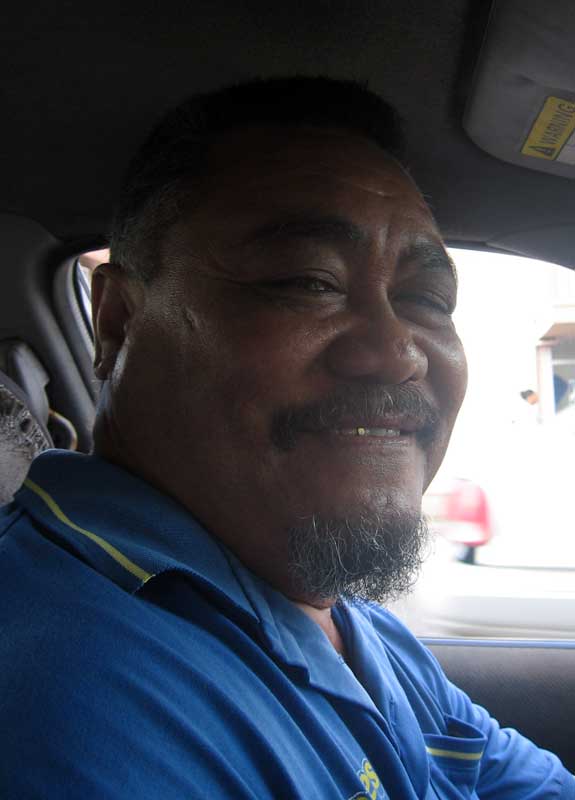 I asked the taxi driver (pictured here) to stop the car and I hopped out to have a chat with the man. I enquired as to why he was casually walking around in my clothes. Thanks to my poor command of Samoan and his equally poor command of English, we didn't make much progress. At just the right moment, my taxi driver stepped out of the car and proceeded to give the security guard what seemed like a fair bollocking. A hasty conversation ensued and finally, with smiles all around, claps on the back and handshakes, we parted ways.
Back in the taxi and somewhat bewildered, I asked the driver what had just transpired. He assured me that the security guard would wash and return my clothes tomorrow. It seems his threat of taking me immediately to the police (!) seems to have carried some weight in the conversation. Fair enough.
Still, my driver was not satisfied. He drove us down to the fale owned by the pulenu'u of my village to see if he was around. I assured him that it was unnecessary and that I would talk to my "landlord". Satisfied, he proceeded to drive me to my destination.
So, it seems that (at least some of) my clothes may be coming back to me after all. A pleasant surprise. I also take heart in the knowledge that at least one person out there approves of my taste in clothing. Result!
And as for the taxi driver, Fa'apine, well he's a legend. He stepped in to help me without a moment's hesitation. A typical demonstration of the amazing attitude of the overwhelming majority of people I've met in my time here. Fa'apine; fa'afetai tele lava sole. Ou te fa'amoemoe o lau Eagles e tatau ona manu malo i le vaiaso fou!
Thursday, August 24, 2006
Apia's drinking problem worsens
Three weeks ago, on advice from the Liquor Board, police issued closure notices to six popular nightclubs in Apia. Complaints from Apia village matai about underage drinking, fights, damage to property and the clubs operating beyond the midnight curfew were given as the justifications for the decision. As best I can ascertain, these were general complaints; there was not a single specific incident to which the Liquor Board referred in making their decision.
On Tuesday this week the Liquor Board ended two weeks of deliberations and decided to extend the closure period for a further three months. The decision, according to chairman Tuu'u Anasi'i Leota, would allow the board "to look at the social impact of our decision." They don't need three months to see the social impact; it's started already.
The first "social impact" of the board's decision is the immediate unemployment of almost 100 workers. Of the six nightclubs, only Lighthouse has been able to retain all of their staff because of the catering business they also operate.
With ongoing expenses such as rent, electricity, water and National Provident Fund contributions to staff, and unable to generate income, it's looking increasingly likely that a number of the clubs will simply shut down. Perhaps the next social impact the board can expect to see will be a strip of rundown, vacant buildings right in the heart of Apia.
On Tuesday this week the Liquor Board ended two weeks of deliberations and decided to extend the closure period for a further three months. The decision, according to chairman Tuu'u Anasi'i Leota, would allow the board "to look at the social impact of our decision." They don't need three months to see the social impact; it's started already.
The first "social impact" of the board's decision is the immediate unemployment of almost 100 workers. Of the six nightclubs, only Lighthouse has been able to retain all of their staff because of the catering business they also operate.
With ongoing expenses such as rent, electricity, water and National Provident Fund contributions to staff, and unable to generate income, it's looking increasingly likely that a number of the clubs will simply shut down. Perhaps the next social impact the board can expect to see will be a strip of rundown, vacant buildings right in the heart of Apia.
Monday, August 21, 2006
Vale Dennis
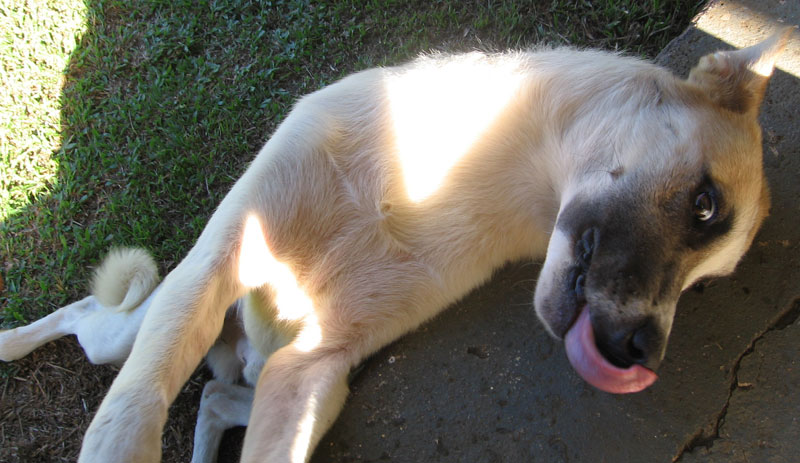 For the last seven or eight months I've been fortunate enough to enjoy the company of a wonderfully happy (if fairly stupid) dog called Dennis. He would accompany me on walks on the weekend, wait for the bus in the mornings with me (and others) and more often than not be waiting for me in the afternoon when I returned home.
Apparently he would on occasion chase little kids around the village and could be a bit aggressive at times but I never saw it. Sure, he was an absolute pain in the backside from time to time (dirty paw prints don't look good on freshly laundered white shirts for example) but he was a genuinely happy and fun friend to have around.
Yesterday Dennis came to my place in the morning and was moping around a lot. I didn't think much of it except that perhaps he'd been in a fight with other dogs and was coming to my place to rest. Sadly, my assessment was very wrong.
Over the course of the next couple of hours he became increasingly lethargic and refused to budge from my laundry. When I discovered him lying in his own vomit I called a friend of mine who works at the Animal Protection Society (APS) and she in turn called the vet. We were far too late. We buried Dennis in the park next to my house. He will be sorely missed.
Sadly, dogs are poisoned in Samoa all the time. The poison of choice is Paraquat. One of the more widely used herbicides, it's an extremely powerful and nasty drug. For humans, the lethal dose is 35 milligrams per kilogram of body weight. In dogs, the lethal dose is somewhere between 25-50 milligrams per kilogram of body weight. There is no antidote for Paraquat.
Once ingested, Paraquat is distributed by the bloodstream to practically all areas of the body, resulting in systematic organ failure. The liver, lungs, heart and kidneys all fail but it is in the lungs that the damage is most concentrated. Pulmonary oedema is the most common type of failure, the lungs accumulating fluid until they fail. It makes for a particularly horrible way to die.
The frequency with which dogs are poisoned (and otherwise ill-treated) illustrates that there is an enormous need for better education. This is the reason why my friend is at the APS. She develops and implements education programmes for schools and villages. No one contests the need for a dog control programme in Samoa but organisations such as the APS fight to make sure that any programmes are carried out in a sensitive and humane manner. I wish my friend and the APS all the very best of luck in their work.
Friday, August 18, 2006
Court rulings and village rulings
On Wednesday the court handed down its ruling in the case between Su'a and Mulitalo. The two judges found that Mulitalo was guilty of bribery as alleged. The judges arrived at the same outcome though for different reasons. These reasons are very interesting and are bound to have consequences for future cases.
Justice Shepherdson's reasoning rested, as I thought might happen, on where the presentation of o'o is made. Section 97A of the Electoral Act, which sets out the regulations surrounding 'o'o' and 'momoli' speaks of "Constituencies", "Members" (of parliament) and "Candidates for Parliament". As such, Shepherdson has argued that
Justice Slicer's reasoning is, I think, more interesting. He reflected on the nature of modern life in Samoa and how custom changes over time. Specifically, he argued that
Despite their different reasoning, both Justices agreed that Mulitalo committed bribery and found him guilty of corrupt practices. The election result for his constituency was declared void and a by-election will have to be held. Mulitalo will be ineligible to run for candidacy. Su'a will be able to run in the by-election, although events since the court ruling may convince him that to do otherwise.
Mere hours after the court ruling was handed down, the maota (headquarters) of the Su'a family in Lano village burnt to the ground. Su'a family members residing in Lano have suggested that the residence appeared to have been doused with fuel before being set alight.
Su'a matai Fa'atoafe Kaisala said that "the persons who burnt down the house were weak of mind because ahead of them was a possible fine of 100 sows and baishment from the village." Not to mention the potential for legal proceedings.
Police are currently investigating the fire and have been questioning many Lano village members. Lano's top ranked orator Malaeulu Lafaele told the Observer that "the matter [of the fire] would be dealt with when their village meets next, perhaps next week."
In spite of the arson attack, Lano village elders are insistent that conflict has not broken out in their village. I'm not so sure. Over the weekend a group of matai publicly supported Su'a even after the pulenu'u of Lano had stated that the ostracism order against Su'a would not be dropped. It would appear that this is no longer just about the tensions between village and legal rule. The tension now seems to exist within the village power structure itself.
Justice Shepherdson's reasoning rested, as I thought might happen, on where the presentation of o'o is made. Section 97A of the Electoral Act, which sets out the regulations surrounding 'o'o' and 'momoli' speaks of "Constituencies", "Members" (of parliament) and "Candidates for Parliament". As such, Shepherdson has argued that
There remains the vital question which is whether the "o'o" and "momoli", in order to gain exemption from illegality, must be held within the territorial limits for the particular constituency.
In my opinion, s97A should be construed so that a "o'o" and "momoli" referred to in the section is limited to those made within the territorial limits of the constituency of the Member or Candidate for Parliament who makes the particular presentation.
Justice Slicer's reasoning is, I think, more interesting. He reflected on the nature of modern life in Samoa and how custom changes over time. Specifically, he argued that
Culture and traditions adapt to new conditions. If they do not they die or are lost...More people come to work and live in Apia. Their children live and are educated in the city. Apia is a significant provider of facilities and employment. But the electors retain their identity and voting rights through their villages and through those villages their constituency. But there are compelling reasons to conclude that the traditional presentation ought not be adapted to permit the holding of 'o'o' and 'momoli' in Apia. If Apia, why not somewhere else? Should there be one for each constituency and each member or candidate?...Will the extension of custom harm the villages as political units? These are complex and important matters requiring time for consideration. They are matters which ought, at this time, remain the province of the Parliament. I do not conclude that as of November 2005 the traditional presentation, because of change of custom, permitted its making outside of the Constituency. This Court ought not legislate change, but only determine whether change has occured. I am not satisfied that there has been a change of custom.
Despite their different reasoning, both Justices agreed that Mulitalo committed bribery and found him guilty of corrupt practices. The election result for his constituency was declared void and a by-election will have to be held. Mulitalo will be ineligible to run for candidacy. Su'a will be able to run in the by-election, although events since the court ruling may convince him that to do otherwise.
Mere hours after the court ruling was handed down, the maota (headquarters) of the Su'a family in Lano village burnt to the ground. Su'a family members residing in Lano have suggested that the residence appeared to have been doused with fuel before being set alight.
Su'a matai Fa'atoafe Kaisala said that "the persons who burnt down the house were weak of mind because ahead of them was a possible fine of 100 sows and baishment from the village." Not to mention the potential for legal proceedings.
Police are currently investigating the fire and have been questioning many Lano village members. Lano's top ranked orator Malaeulu Lafaele told the Observer that "the matter [of the fire] would be dealt with when their village meets next, perhaps next week."
In spite of the arson attack, Lano village elders are insistent that conflict has not broken out in their village. I'm not so sure. Over the weekend a group of matai publicly supported Su'a even after the pulenu'u of Lano had stated that the ostracism order against Su'a would not be dropped. It would appear that this is no longer just about the tensions between village and legal rule. The tension now seems to exist within the village power structure itself.
Manase, Mt. Matavanu, dinner and back home
 After saying goodbye to Maka we drove from Papa to Manase. Along the way we passed through some beautiful parts of the island (including the quite picturesque Asau harbour). Manase is the most popular destination for tourists to Savaii and there are several places to stay. Tanu's would probably attract the majority of custom given its cheap nightly rate of $50 Tala but Jane's, Vacations and Stephenson's all have many guests. Tanu's was booked out for Sunday night so we chose to stay at Vacations. At $75 we could afford it and their fales looked like they were in good shape. We didn't regret our decision.
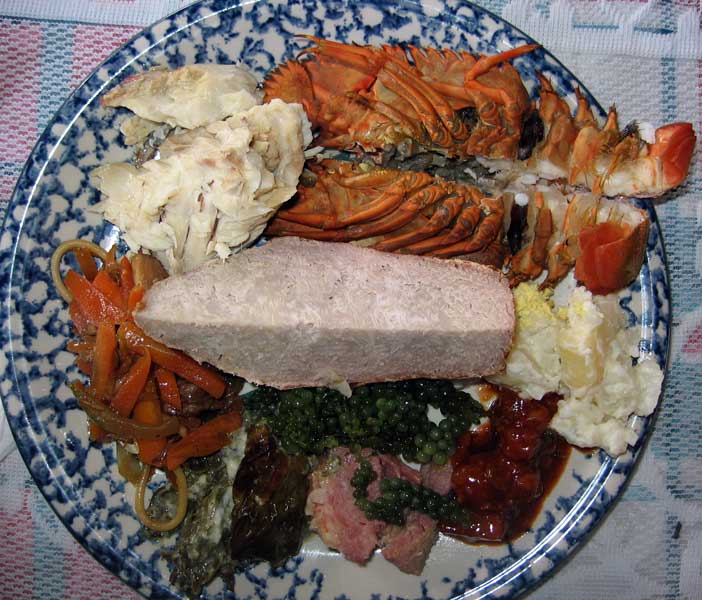
We timed our arrival perfectly, climbing out of the car to see the Sunday to'onai lunch waiting for us. It was a feast. Bugs, palusami, pig and taro, oka. Fresh salty seaweed, baked fish, potato salad and stir fried vegetables. We ate our fill then proceeded to our fales where all four of us crashed out for an afternoon nap. Eating's hard work you know.
The rest of our time at Vacations was spent in very similar fashion. We either slept or floated in the ocean. We'd covered a fair bit of ground by this stage so it was good to take some time out and enjoy doing nothing.
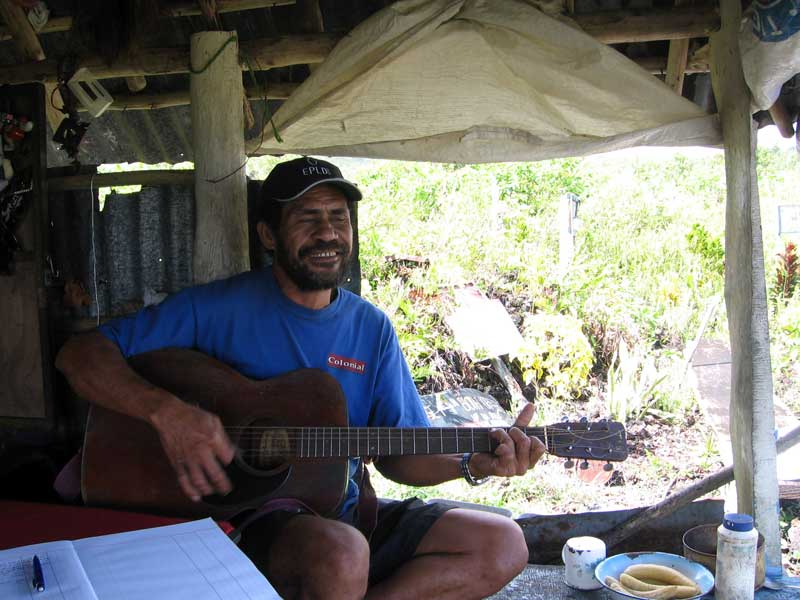 Not long after breakfast we packed up and headed back towards Asau harbour, turning inland at the village of Safune. Our destination was Mt. Matavanu. Mt. Matavanu erupted between 1905 and 1911, its lava flows spilling north and north-east towards the villages of Asau and Saleua especially. The lava fields I visited earlier in the year are the result.
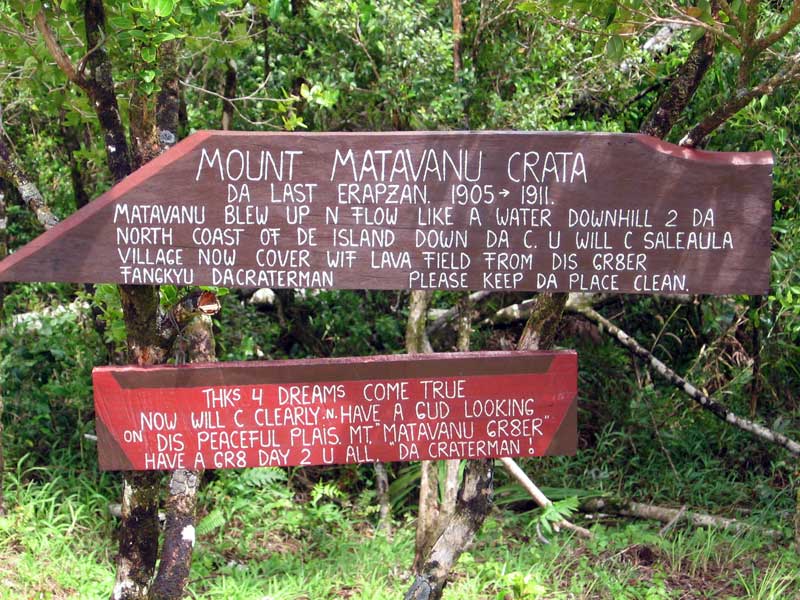 Thanks to the efforts of "Da Craterman" getting to the top of the mountain is much easier than it used to be. We were able to drive most of the way, stopping once we reached the Craterman's small hut. From there we walked with the Craterman as our guide.
 He's an intriguing character, the Craterman. He spends his days in his hut up the mountain waiting for visitors but he doesn't pass his time idly. He maintains the tracks leading up and around the mountain and spends a lot of time fashioning signs to place along the way. For a fee, interested visitors can have their very own sign made. Creating these signs takes a little time, so the Craterman sends a photo of the sign and a letter to the people who have paid for it once it's completed.
The Craterman also keeps statistics about the number of signs he's created (541 as of this writing) and the number of visitors from different countries he's received. By his latest count he's had people from 85 different countries come to Mt. Matavanu.
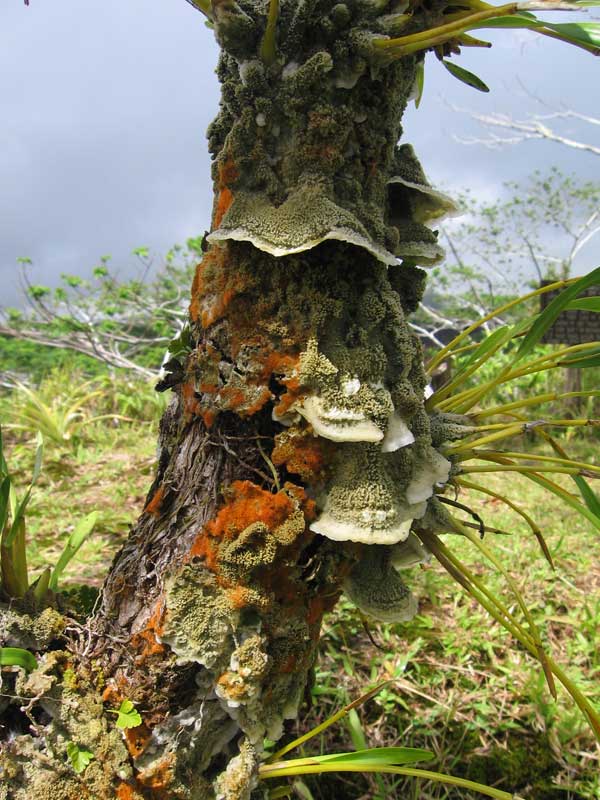
 We walked with the Craterman up to the first of two craters. The view was amazing. Standing at its lip, we were able to look down into dense foliage. Countless trees, shrubs, vines, moulds and fungii populate the crater and we had the perfect view to appreciate them. Looking north towards the coast we could see Asau harbour and Manase.
As the rain started to fall we made our way back to the Craterman's hut and our car. We said our farewells and drove back down to the main road. We stopped in at a neighbouring village for a swim in freshwater pools and chatted with a Peace Corps volunteer stationed there. Afterwards we headed back through Manase and drove along the east coast on the way to the wharf at Salelologa. After two and a half days our road trip was coming to an end. Or so we thought.
We reached Salelologa and joined the queue of vehicles for the 4pm ferry. We discovered that the ferry was already booked to capacity and we were placed on stand-by. We waited and waited and eventually realised that we were not going to get the car onboard. The next service with barely any spare car space would be the 10am ferry the next day.
 We said goodbye to Alexa who absolutely had to return to Apia that day and drove back to Clair's place in Palauli. There we caught up with Maka and another Peace Corps volunteer Laura. We decided to take advantage of the hire car and picked up a couple more Peace Corps before driving around to the east coast of the island for dinner at the Italian restaurant there. We had a great meal and a lot of fun. Once again the language competency of the Peace Corps shone through as they casually joked with our waiter and proprietor of the restaurant.
At the conclusion of the evening we drove the Peace Corps back to their village not far from Clair's (Satupaitea I think) and returned to Clair's to crash out for the night. The next morning we returned to the wharf and managed to get ourselves aboard the 10am ferry. Our trip from the wharf was a little interesting, as our car developed engine problems but we made it home in one piece.
All in all, it was an excellent weekend. We saw some amazing things, hung out with great people and had a lot of fun. Savaii is a wonderful place and is well worth visiting.
Wednesday, August 16, 2006
A visit to the village of Papa
After we left Falealupo we returned to the main road and drove another three or four kilometres down the road to the village of Papa. With the exception of Clair we all work and live in Apia so we were keen to visit Maka and see an example of how the village-based Peace Corps volunteers live.
 Maka lives with Papa's pulenu'u (town mayor). One of the first orders of business after his arrival was the construction of his fale. Maka and twenty or so untitled men built the small one person fale in two days. With this out of the way, Maka was able to start working on his two year project, focusing on sustainable crops and agricultural techniques for use within the village. In the year that he's been in Papa he's built a small nursery and a large garden which provide the clippings and seeds he needs to help other families within the village develop more robust farming practices. He has a range of different crops growing successfully including three types of basil, spinach, sweet potato vine, three types of tomato and watermelon.
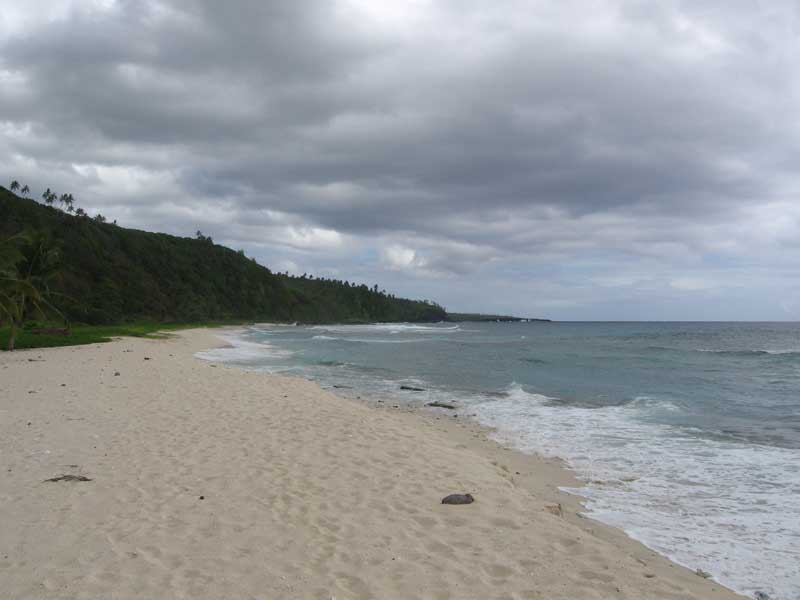
After a brief tour of his gardens we hopped in the car and drove down the (rocky dirt) road to a secluded beach. The land is owned by a matai of Papa village but he doesn't use it too much. He's allowed to let Maka head down there whenever he likes. In essence, Maka has his own private beach!
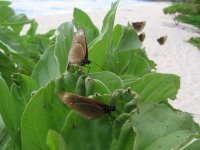 It was a little windy and overcast when we arrived but still beautiful. We had a wander along the beach and chatted away. We came across a plant which was covered in butterflies. Maka told us that the sap of the plant was what attracted the butterflies and to demonstrate the point he used his machete to hack away the tips of the leaves. Within seconds the butterflies went crazy and swarmed over them.
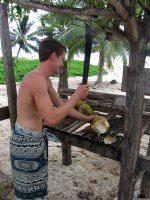
Whilst we watched the butterflies Maka headed off to a nearby coconut tree and hacked away until he'd brought four coconuts down. He then showed us how to prepare coconuts for drinking. I've done this before with a large stick and husked them that way, but this was the first time I've seen it done solely with a machete. Two of the coconuts were niu - young drinking coconuts - and two were popo, the older coconuts good for the meat. After we drank the two niu, Maka used his machete to make a spoon from the remaining husk of the niu and then chopped them in half so we could scoop out and enjoy the young jelly-like meat. Very tasty indeed.
 Maka leads a very different life to ours in Apia. His resources are considerably more limited but his experience is far more in line with the majority of Samoans. One of the most profound differences is that of our language skills. Listening to Maka converse freely with his host family was illuminating. The Peace Corps program begins with three months of fairly intensive language lessons. By comparison, we have five hours of lessons. I couldn't help but feel a little envious. That said, if I was really serious about picking up the language I'd have arranged private lessons and pushed myself much harder. Maybe next time.
A little while after we finished off the coconuts we drove back to Maka's fale and said our farewells. Our day was still young and we had more ground to cover before stopping for the day. Our next stop would be the village of Manase where an afternoon of relaxation awaited us.
 Maka lives with Papa's pulenu'u (town mayor). One of the first orders of business after his arrival was the construction of his fale. Maka and twenty or so untitled men built the small one person fale in two days. With this out of the way, Maka was able to start working on his two year project, focusing on sustainable crops and agricultural techniques for use within the village. In the year that he's been in Papa he's built a small nursery and a large garden which provide the clippings and seeds he needs to help other families within the village develop more robust farming practices. He has a range of different crops growing successfully including three types of basil, spinach, sweet potato vine, three types of tomato and watermelon.
After a brief tour of his gardens we hopped in the car and drove down the (rocky dirt) road to a secluded beach. The land is owned by a matai of Papa village but he doesn't use it too much. He's allowed to let Maka head down there whenever he likes. In essence, Maka has his own private beach!
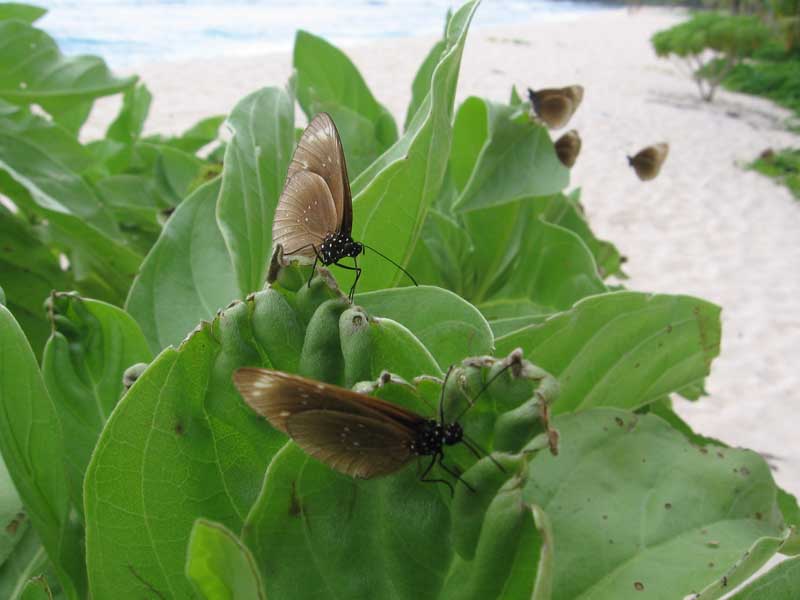 It was a little windy and overcast when we arrived but still beautiful. We had a wander along the beach and chatted away. We came across a plant which was covered in butterflies. Maka told us that the sap of the plant was what attracted the butterflies and to demonstrate the point he used his machete to hack away the tips of the leaves. Within seconds the butterflies went crazy and swarmed over them.
Whilst we watched the butterflies Maka headed off to a nearby coconut tree and hacked away until he'd brought four coconuts down. He then showed us how to prepare coconuts for drinking. I've done this before with a large stick and husked them that way, but this was the first time I've seen it done solely with a machete. Two of the coconuts were niu - young drinking coconuts - and two were popo, the older coconuts good for the meat. After we drank the two niu, Maka used his machete to make a spoon from the remaining husk of the niu and then chopped them in half so we could scoop out and enjoy the young jelly-like meat. Very tasty indeed.
 Maka leads a very different life to ours in Apia. His resources are considerably more limited but his experience is far more in line with the majority of Samoans. One of the most profound differences is that of our language skills. Listening to Maka converse freely with his host family was illuminating. The Peace Corps program begins with three months of fairly intensive language lessons. By comparison, we have five hours of lessons. I couldn't help but feel a little envious. That said, if I was really serious about picking up the language I'd have arranged private lessons and pushed myself much harder. Maybe next time.
A little while after we finished off the coconuts we drove back to Maka's fale and said our farewells. Our day was still young and we had more ground to cover before stopping for the day. Our next stop would be the village of Manase where an afternoon of relaxation awaited us.
Tuesday, August 15, 2006
The last place on earth

Savaii, much more so than 'Upolu, bears the scars of nature's power. Volcanic eruptions and cyclone activity have made an indelible mark on the landscape and the people of the island. The village of Falealupo, on the western most tip of Savaii, bears that mark more than most.
 Today, the village of Falealupo is a mere shadow of its former self. From the second to the fifth of February in 1990, cyclone Ofa battered the north-western part of Savaii, wreaking considerable destruction. Strong winds, heavy rain and rough seas led to the complete destruction of Falealupo. The village was abandoned. Resources were recycled as best as possible but the villagers chose to leave some ruined buildings stand as they were, as testimony to both the power of cyclone Ofa and the village of Falealupo itself. The most striking of these is the Catholic church that stands close to the water's edge.
With its roof long gone and walls crumbling away the church is slowly giving way to nature. Trees, vines and low shrub are reclaiming the structure, as they have much of the surrounding landscape. The concrete walls are stained with mould and streaked with cracks. The few remaining bas relief sculptures along the walls are losing their features.
 The remains of Falealupo were not the main reason we headed there this weekend. The International Date Line passes within about 60 kilometres of Samoa, making Falealupo the last place on earth. It also means it is possible to watch the sun set over today and tomorrow simultaneously.
We took some photos of each of us standing at the "edge of the world" (as you do) and watched the sun set. It was quite beautiful. All the while I couldn't help but laugh and think of Monty Python's Crimson Permanent Assurance and how "they sailed off into the ledgers of history...or so it would have been, if certain modern theories concerning the shape of the world had not proved to be...disastrously wrong." Unlike the Crimson Permanent Asssurance, we didn't see the edge of the world, but we did see today and tomorrow all at once, which I'm more than happy about.
We spent our evening in beach fales about a kilometre down the road from the ruined church. Whilst there we bumped into a friend of ours, Maka, who is a US Peace Corps volunteer living on Savaii. He was heading home to the nearby village of Papa and invited us to visit him the following day. After breakfast and a quick swim, we packed our bags into the car and drove away from the last place on earth to take him up on his offer.

Olemoe waterfall and Alofaaga blowholes
 A few friends and I have just spent three (and a bit) days on Savaii touring around the island. It was great fun; we managed a complete lap of the island, seeing sights I'd never seen before, eating great food and catching up with friends.
After completing the hour ferry ride from 'Upolu to Savaii's port at Salelolga, our first port of call was the village of Palauli. There we collected Clair, a fellow Australian volunteer who works at a Marist school in the neighbouring village of Vailoa. From there we travelled about a mile or so up the road to stop off at the beautiful Olemoe waterfall. I've been to Olemoe before and like the last time, this visit didn't disappoint. Recent (unseasonally large) rainfall guaranteed that the waterfall was running at full steam. In her many visits, Clair hadn't seen it as powerful as it was on Saturday. The water was cold and very refreshing and the little freshwater prawns were nibbling our toes as we relaxed.
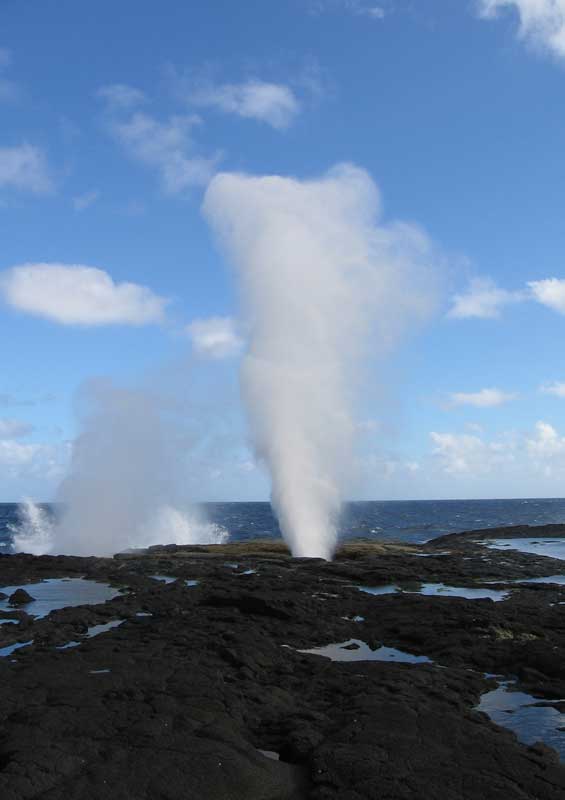 After our swim we returned to the main road and continued west. Our destination was the village of Taga. Located at the south-western tip of Savaii, Taga is home to the Alofaaga blowholes, perhaps the most powerful blowholes in the South Pacific. The coastline here is very rugged. Past volcanic activity has resulted in the inter-tidal area being almost entirely covered in lava flow and sharp lava cliffs jut up from the sea. The eponymous coconut trees are, unlike most places, some distance from the water.
 When we arrived the tide was high, which meant that the blowholes would be operating with some ferocity. We paid the village fee to enter the area and had a young village member hop into the car to show us around. We made our way to a parking area then walked across the lava to the blowholes. There, our guide collected some coconut husks and used them to demonstrate the power of the blowholes. We watched as the husks were shot skywards, easily seven or eight metres high.
We were on a little bit of a time limit so didn't really explore the Alofaaga region of Taga as much as we would have liked. Those with more time might consider the walking trail that leads to an old village called Fagaloa, the lava tubes and caves to explore and some rock pools that are safe enough for swimming. As for us, we bundled ourselves back in the car and set our course for the last place on earth.
Subscribe to:
Posts (Atom)