Wednesday, August 16, 2006

A visit to the village of Papa

After we left Falealupo we returned to the main road and drove another three or four kilometres down the road to the village of Papa. With the exception of Clair we all work and live in Apia so we were keen to visit Maka and see an example of how the village-based Peace Corps volunteers live.

Maka lives with Papa's pulenu'u (town mayor). One of the first orders of business after his arrival was the construction of his fale. Maka and twenty or so untitled men built the small one person fale in two days. With this out of the way, Maka was able to start working on his two year project, focusing on sustainable crops and agricultural techniques for use within the village. In the year that he's been in Papa he's built a small nursery and a large garden which provide the clippings and seeds he needs to help other families within the village develop more robust farming practices. He has a range of different crops growing successfully including three types of basil, spinach, sweet potato vine, three types of tomato and watermelon.

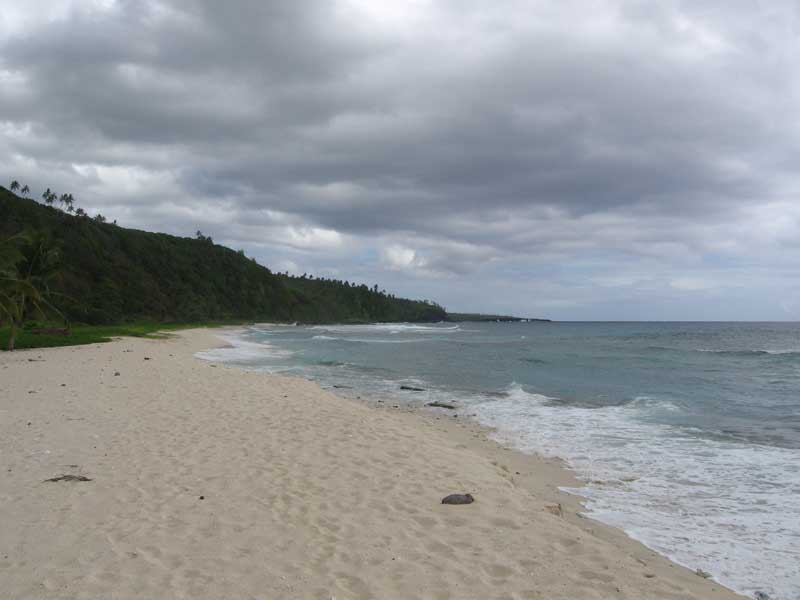
After a brief tour of his gardens we hopped in the car and drove down the (rocky dirt) road to a secluded beach. The land is owned by a matai of Papa village but he doesn't use it too much. He's allowed to let Maka head down there whenever he likes. In essence, Maka has his own private beach!
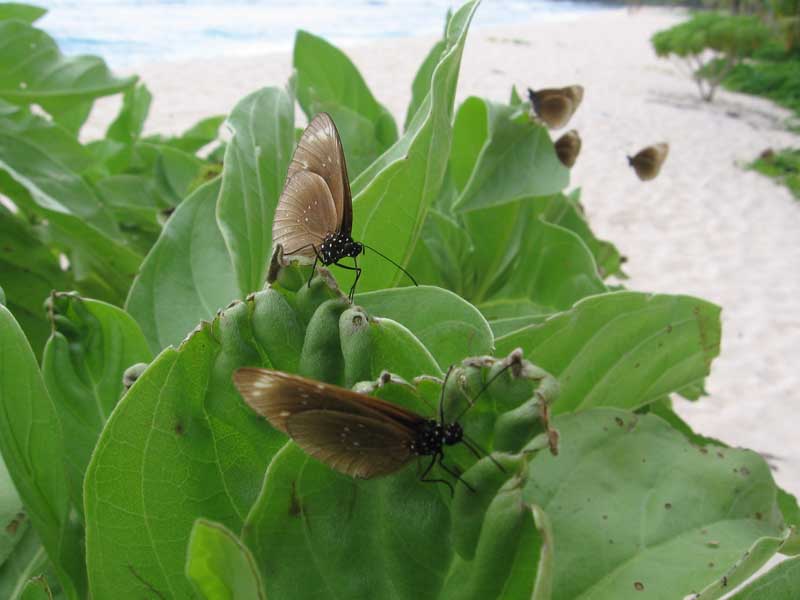
It was a little windy and overcast when we arrived but still beautiful. We had a wander along the beach and chatted away. We came across a plant which was covered in butterflies. Maka told us that the sap of the plant was what attracted the butterflies and to demonstrate the point he used his machete to hack away the tips of the leaves. Within seconds the butterflies went crazy and swarmed over them.

Whilst we watched the butterflies Maka headed off to a nearby coconut tree and hacked away until he'd brought four coconuts down. He then showed us how to prepare coconuts for drinking. I've done this before with a large stick and husked them that way, but this was the first time I've seen it done solely with a machete. Two of the coconuts were niu - young drinking coconuts - and two were popo, the older coconuts good for the meat. After we drank the two niu, Maka used his machete to make a spoon from the remaining husk of the niu and then chopped them in half so we could scoop out and enjoy the young jelly-like meat. Very tasty indeed.

Maka leads a very different life to ours in Apia. His resources are considerably more limited but his experience is far more in line with the majority of Samoans. One of the most profound differences is that of our language skills. Listening to Maka converse freely with his host family was illuminating. The Peace Corps program begins with three months of fairly intensive language lessons. By comparison, we have five hours of lessons. I couldn't help but feel a little envious. That said, if I was really serious about picking up the language I'd have arranged private lessons and pushed myself much harder. Maybe next time.

A little while after we finished off the coconuts we drove back to Maka's fale and said our farewells. Our day was still young and we had more ground to cover before stopping for the day. Our next stop would be the village of Manase where an afternoon of relaxation awaited us.

Tuesday, August 15, 2006

The last place on earth


Savaii, much more so than 'Upolu, bears the scars of nature's power. Volcanic eruptions and cyclone activity have made an indelible mark on the landscape and the people of the island. The village of Falealupo, on the western most tip of Savaii, bears that mark more than most.

Today, the village of Falealupo is a mere shadow of its former self. From the second to the fifth of February in 1990, cyclone Ofa battered the north-western part of Savaii, wreaking considerable destruction. Strong winds, heavy rain and rough seas led to the complete destruction of Falealupo. The village was abandoned. Resources were recycled as best as possible but the villagers chose to leave some ruined buildings stand as they were, as testimony to both the power of cyclone Ofa and the village of Falealupo itself. The most striking of these is the Catholic church that stands close to the water's edge.

With its roof long gone and walls crumbling away the church is slowly giving way to nature. Trees, vines and low shrub are reclaiming the structure, as they have much of the surrounding landscape. The concrete walls are stained with mould and streaked with cracks. The few remaining bas relief sculptures along the walls are losing their features.

The remains of Falealupo were not the main reason we headed there this weekend. The International Date Line passes within about 60 kilometres of Samoa, making Falealupo the last place on earth. It also means it is possible to watch the sun set over today and tomorrow simultaneously.

We took some photos of each of us standing at the "edge of the world" (as you do) and watched the sun set. It was quite beautiful. All the while I couldn't help but laugh and think of Monty Python's Crimson Permanent Assurance and how "they sailed off into the ledgers of history...or so it would have been, if certain modern theories concerning the shape of the world had not proved to be...disastrously wrong." Unlike the Crimson Permanent Asssurance, we didn't see the edge of the world, but we did see today and tomorrow all at once, which I'm more than happy about.

We spent our evening in beach fales about a kilometre down the road from the ruined church. Whilst there we bumped into a friend of ours, Maka, who is a US Peace Corps volunteer living on Savaii. He was heading home to the nearby village of Papa and invited us to visit him the following day. After breakfast and a quick swim, we packed our bags into the car and drove away from the last place on earth to take him up on his offer.

Olemoe waterfall and Alofaaga blowholes

A few friends and I have just spent three (and a bit) days on Savaii touring around the island. It was great fun; we managed a complete lap of the island, seeing sights I'd never seen before, eating great food and catching up with friends.

After completing the hour ferry ride from 'Upolu to Savaii's port at Salelolga, our first port of call was the village of Palauli. There we collected Clair, a fellow Australian volunteer who works at a Marist school in the neighbouring village of Vailoa. From there we travelled about a mile or so up the road to stop off at the beautiful Olemoe waterfall. I've been to Olemoe before and like the last time, this visit didn't disappoint. Recent (unseasonally large) rainfall guaranteed that the waterfall was running at full steam. In her many visits, Clair hadn't seen it as powerful as it was on Saturday. The water was cold and very refreshing and the little freshwater prawns were nibbling our toes as we relaxed.

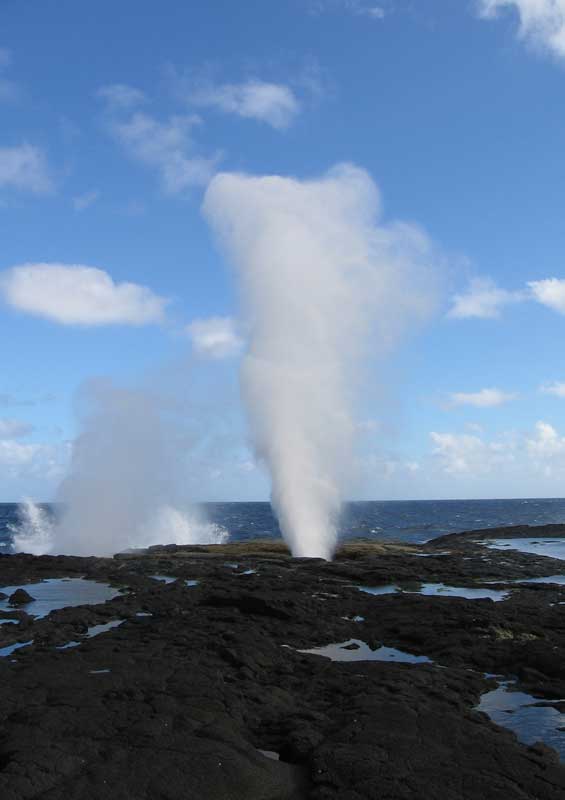
After our swim we returned to the main road and continued west. Our destination was the village of Taga. Located at the south-western tip of Savaii, Taga is home to the Alofaaga blowholes, perhaps the most powerful blowholes in the South Pacific. The coastline here is very rugged. Past volcanic activity has resulted in the inter-tidal area being almost entirely covered in lava flow and sharp lava cliffs jut up from the sea. The eponymous coconut trees are, unlike most places, some distance from the water.

When we arrived the tide was high, which meant that the blowholes would be operating with some ferocity. We paid the village fee to enter the area and had a young village member hop into the car to show us around. We made our way to a parking area then walked across the lava to the blowholes. There, our guide collected some coconut husks and used them to demonstrate the power of the blowholes. We watched as the husks were shot skywards, easily seven or eight metres high.

We were on a little bit of a time limit so didn't really explore the Alofaaga region of Taga as much as we would have liked. Those with more time might consider the walking trail that leads to an old village called Fagaloa, the lava tubes and caves to explore and some rock pools that are safe enough for swimming. As for us, we bundled ourselves back in the car and set our course for the last place on earth.

Saturday, August 12, 2006

Old versus new (cont.)

One consequence of Su’a’s court submission has been his ostracising from the village of Lano. Unhappy that he continued with his petition against Mulitalo, Lano matai decided to banish him “for the good of the village”. This decision is not unusual or rare. I’ve seen reports of three such banishment orders since I’ve been here. What is interesting about this case however is the court’s response. The Observer reports that Justice Pierre Slicer told the Lano pulenu’u, Malaeulu Amoni, that “Lano was not more powerful than the Legislative Assembly, the Constitution, the Electoral Act, the Head of State, or the Supreme Court.” As such, the ostracism of Su’a was “unlawful conduct.” Justice Slicer, along with Justice Tom Shepherdson (both judges from New Zealand Australia), ordered the matai of Lano to lift the ostracism resolution or “be jailed by us for contempt of court.” A well-established and understood mechanism of the fa’asamoa has been overruled by Samoa’s adopted legal system.

“K.T” asked in Wednesday’s Observer,

Who are these judges to raise havoc about the cultural values our people have cherished for so long?

Despite the hardships, our matai system has never failed to impose peace and unity amongst our people. Our forefathers must be turning in their graves and we need to solidify their profound wish i.e. Tofia e le Atua Samoa ina ia pulea e matai. (God chose Samoa to be governed by matais).

Such forceful instructions levelled at the Lano village mayor is an unprecedented call to all other village mayors that not following the norms of the Westminster model could be reason to waive and abandon their cultural prowess in this traditional culture that has survived and had persevered for centuries.

What we have guarded with life is suddenly declared illegal…and this court decision is seen as rather hostile towards the fa’asamoa and coming from a judge, I feel it is simply inappropriate.

This is not an uncommon feeling. A vox pop in Thursday's newspaper was dominated by similar sentiment. There is a very real need to find ways of satisfying both the traditional and modern systems of power and regulation in Samoa. Whilst it might prove unpopular from time to time, I suspect it is going to be legal cases such as the one between Su'a and Mulitalo, where legal interpretations of the fa'asamoa end up being defined, that will be the major drivers for this process.

Old versus new

At times, the tensions between the traditional fa'asamoa (Samoan way) and the modern world become quite visible. The recent debate surrounding the issue of homosexuality is one example but it is within the legal sphere that this tension is most visible. The Westminster system is still new to Samoa, having only been established at the time of the creation of an independent Samoa. Unsurprisingly, forty years later, understanding and incorporating the fa'asamoa within the Westminster system is an ongoing challenge.

Shortly after the General Elections in March this year, court petitions were brought against several of the successful candidates. All the petitions alleged bribery had taken place to secure the votes of individuals, and more commonly, of entire villages. Whilst most of the petitions were withdrawn, two petitions went to trial. One has been settled already and the other is currently being heard in court.

The petition currently being heard in court, brought by Su'a Rimoni Ah Chong against Mulitalo Seali'imalietoa Siafausa Viu, has focused around the presentation of gifts by Mulitalo prior to the election. The presentations of gifts, known as an o'o, is a long standing tradition within the fa'asamoa. Individuals newly bestowed with matai titles always present an o'o to their fellow matai in their fono ale nu'u (village meeting). The presentation is often quite elaborate, with an ava ceremony and exchanges of very formal speeches.

The Electoral Act states that "the traditional presentation of 'o'o' and 'momoli' by a Member or candidate for Parliament...shall not be considered as treating or bribery...provided that the presentation is made within the period commencing with the 180th day and ending within the 90th day from the expiry of the then Parliament at five years from the date of the last preceding General Elections." The timing of the presentation is not being challenged here. The heart of Su'a's submission lies in how the term "traditional presentation" is to be legally interpreted. He alleges that as Mulitalo's presentation was not held in his own constituency, was not presented only to matai, did not include an ava ceremony nor any exchange of speeches, it could not be considered an o'o.

Is a "traditional presentation of 'o'o'" one that has an ava ceremony, formal speeches and that is only presented to matai, as Su'a claims? Furthermore, in the context of an election, can such presentations only be considered o'o if they take place within the presenter's own constituency? A legal definition of a deeply held Samoan tradition is required before these questions can be answered.

Sunday, August 06, 2006

Some good, some bad

Tonight I sleep in a house with no electricty nor running water. Unfortunately, it's my house.

In the span of less than twelve hours I've had first the electricity, then the water, stop. On a Sunday. I'm obviously having a run of good luck.

Still, it's been quite pleasant to sit and read a book by candlelight and enjoy the sounds of the village. The dogs are keeping largely quiet tonight; a nice change from the last couple of weeks. The night sky has been wonderful too, a waxing moon casting its soft light over everything. It's almost like sleeping at the beach in an open air fale.

Thursday, August 03, 2006

A few quiet nights in

Crisis! Yesterday the police served temporary shutdown orders to all the major night clubs in Apia. So for the time being, Bad Billy's, Crabbers, Lighthouse, Paddles and RSA night clubs are all shut. Apparently Police have been frustrated by the clubs not meeting their obligations. These include keeping a lid on fights, foul language in public and, in particular, shutting up shop in a very timely fashion on the stroke of midnight.

It was suggested yesterday that in spite of the fact that not all clubs were breaking the rules, the police had decided to shut every single one, on the grounds of "fairness". I wouldn't know about fair but it's true at least that every club is suffering as much as the others.

So how long will the shutdown last? No one's entirely sure yet. One night club owner told me that the order was stated as being "indefinite" but there has already been talk that the clubs will be up and running as per usual tonight. We'll have to wait and see.

In the meantime, patrons will probably just buy cases of beer and sit themselves on the sea wall across from the clubs. There, outside of a controlled club environment, they'll be able to get as drunk as they like, get into as many fights as they wish and not have to go home at midnight. As for me, I think a couple of quiet nights in are in order. (Yeah, right!)

Tuesday, August 01, 2006

Views from up the hill

This afternoon after work I joined a few friends in a walk up Mt Vaea. We didn't take the track normally travelled, rather the one that leads up to the mobile phone and microwave relay station. It's a gravel road all the way up which makes it a little easier to navigate, though one has to be careful about slipping on the gravel on the way back down.

Apart from the health benefits of going for a good walk up a mountain, the reward in the case of Mt Vaea is a fantastic - and different - perspective on Apia. I've been on the roof of the government building a few times, which affords a pretty great view, but the view from the mountain is brilliant.

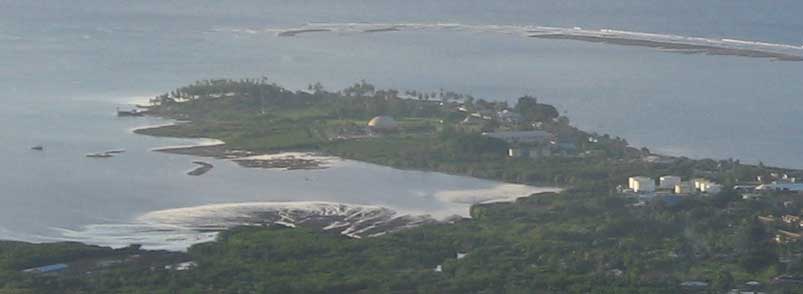
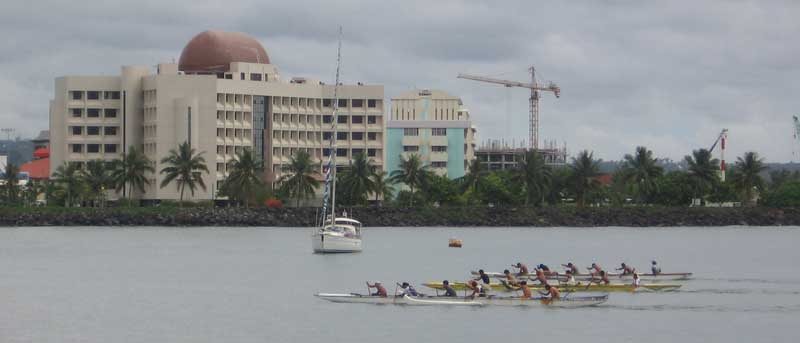
The first shot is towards the north-west. The point just leftof the middle of the shot is all reclaimed land and is home to a few key buildings and organisations in Samoa. The white domed building is Samoa's parliament house. Across the road from the parliament (but not visible here in this closer view) are the offices of the Land and Titles Court, Samoa Broadcasting Corporation and the Yacht club (which has a great restaurant out the back). A bit further up the road, right at the end of the point, is the Meteorology Division. Notice the extent to which the reef stretches out from the coast and those huge clouds are so common here.

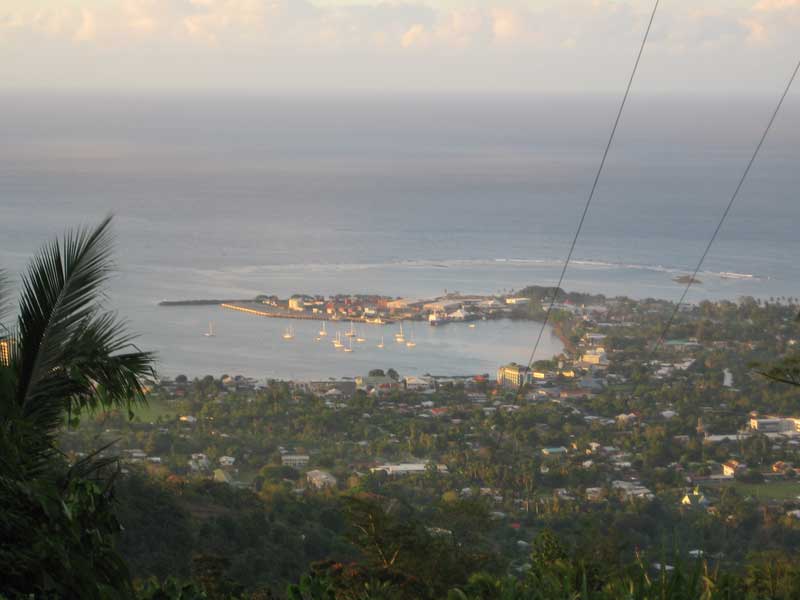
Looking more directly north we had a great view of the eastern part of Apia. It's a great view of Matautu wharf and Aggie Grey's hotel is visible in between the two telegraph wires. The large building to the left is the John Williams building. It houses the head office of the country's electricity company, EPC. It's this side of the harbour where I go paddling each week.

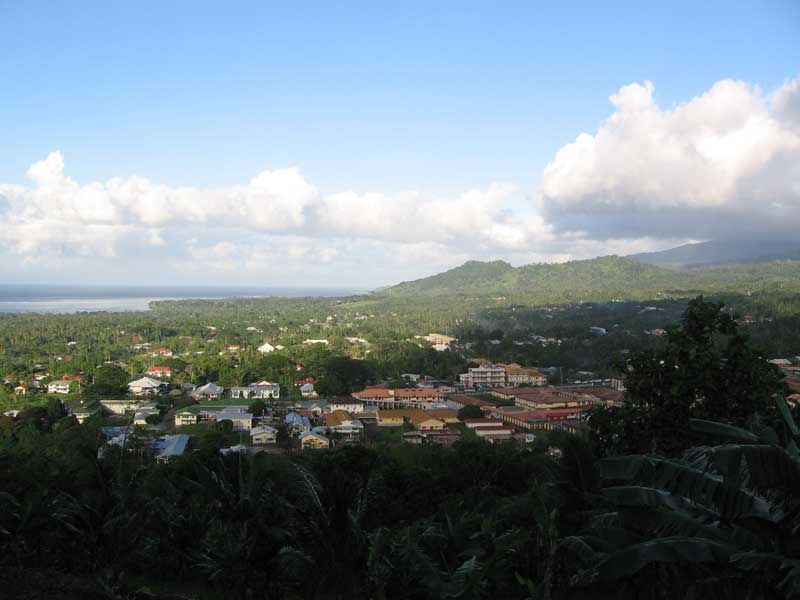
Looking east, we were afforded a great view of the grounds of the national hospital. I knew it was big but never really appreciated the full size of the place until this afternoon (surely that's a good thing right?). Just left of the foot of the mountain in the background is a clear straight strip of grass (I know, it's hard to spot). It's the disused airport at Fagalii-uta. I live about two minutes' walk south from its eastern edge.

Finally, looking towards the south-east, a special treat. There was obviously a bit of rain about as were treated to rather a spectacular rainbow. I captured it peeking through the trees but the thing was enormous. It completed a full arch and its colours were strong and vibrant. Of course, the thing you have to be careful of once you notice the colours of a rainbow getting stronger, is the high chance of impending rain, but we were spared with little more than a very light sprinkle that lasted all of about two minutes.

All up I think we took a bit over an hour to make the walk up and down the mountain. It was a great way to end a day that was mostly spent sitting at a desk staring at a screen. I'll be doing it again I can assure you of that.

Sunday, July 30, 2006

It's regatta season

The second outrigger canoe paddling regatta of the season was held yesterday. A bunch of us have been paddling for a while now but never really in races. The regatta (like the first of the season a few weeks ago) gave us a great chance to get some experience.

We ended up competing against some fairly strong crews as many of the other social teams were unable to make it. As a result we weren't quite able to make the impression on the social division as we did in the first regatta. Nonetheless we had a great time.

The standard race length is 500 metres but there is also a 250 metre sprint and the longer 1500 metre race. The junior men's and open men's teams were the only ones that raced the 1500 metres. The mixed social teams and open women's teams competed the 250 and 500 metre reaces. The photo above shows the open men's teams in the second leg of their 1500 metre race.

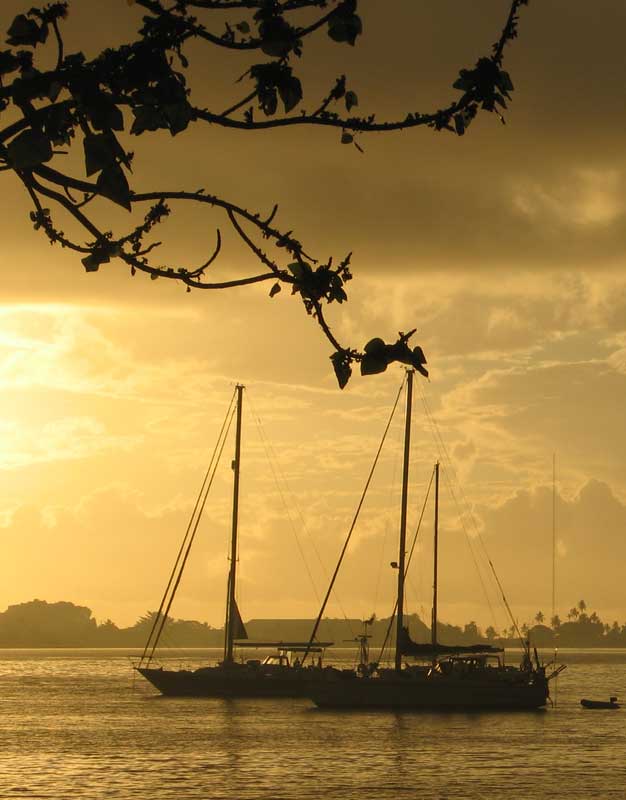
The sun never really came out all day so the temperature was quite mild making for perfect conditions for paddling. At the conclusion of the day however, whilst we were sitting back with a couple of beers, the sun came out from behind the clouds and put on one of the best sunsets I've seen in Samoa.

It was an excellent day, replete with exercise, relaxation, good conversation, remarkable scenery and beer. We're already talking about the next regatta with much anticipation.

Friday, July 28, 2006

Non-verbal communication

One of the features of daily life in Samoa is the extensive use of non-verbal communication. Walk down the street and you'll be nodding your head, raising your eyebrows, grinning, using your eyes and flicking your hand out to quickly wave at a lot of people. It's something you get used to fairly rapidly as it's so immediately obvious.

Some of the non-verbal signals used here are quite backwards to what we're used to in Australia. Meetings are a fine example of a situation where one can be baffled at the conduct of the attendees. I've sat in meetings and watched people clip their toenails, play on their mobile phone, look as if they're falling asleep and otherwise seemingly ignore the speaker. If being spoken to, one may find that the speaker avoids eye contact for the entire conversation. This physical disengagement is a sign of respect. In those meetings, in spite of appearances, everyone is aware of every word that is being spoken.

Other non-verbal signals can inadvertently get you in trouble. If someone senior (in age but particularly in social status) to you is sitting, you should not stand. If you're sitting, never point your feet at someone. I've mentioned the taboos surrounding whistling already.

The one signal that I've really enjoyed seeing is the hand wave. Sure, it's just waving to someone as they (or you) pass by but here in Samoa it's an art form. I've never come across so many unique, odd and humourous ways of waving to someone. Stay in Samoa for any significant period of time and you'll find yourself developing your own style. I have. Several of my palagi friends have too.

This culturally based non-verbal communication isn't the only kind I've learnt since I've been in Samoa though. Thanks to some very good friends I've been learning Samoan sign language. It's heavily based on Auslan which means I'm learning a language that I can use when I'm back in Australia. For a significant portion of the last ten months, I've spent my Monday evenings learning how to fingerspell, expand my vocabulary and converse fluently. It's been immense fun and my friends have been fantastic teachers. I've now reached a point where I can hold fairly involved conversations with my deaf friends without having to ask for the definition of a sign too often.

I find the linguistic characteristics of sign languages fascinating. At the moment I'm learning classifiers, which are a fundamental part of many languages (such as Japanese and Samoan), but particularly important in sign languages. What is most fascinating for me is the spatial grammar that is employed. Meaning is frequently conveyed by a combination of the hands, the facial expression and the body posture in the same moment. Multiplicity of meaning can be derived from changes to just one or all of these information "channels". As an example, I can use a hand sign in reference to myself, then use that same sign but change my facial expression to turn it into a question to the recipient.

There's a wealth of material online about sign languages and Auslan in particular. I'd recommend looking at Wikipedia's entries on sign language and Auslan as a good introduction. The online resource I've benefitted from the most though would have to be the Auslan Signbank. It's an online dictionary of signs (free registration required). You search for the keyword you're interested in and if it's there, you'll see a small video of the sign and relevant definition(s). It's a great idea very well executed.

My classes will continue up until about one or two weeks before I head back to Australia. I do want to keep learning after I leave though. Thankfully, the Deaf Education Network runs a variety of courses in NSW on a regular basis. Organisations in other states have similar offerings.

Thanks to friends here I already have a couple of deaf Samoan-Australians to call upon once I'm back in Sydney. I'm excited as it'll be a great way for me to continue to improve my sign language but also continue my relationship with Samoa and Samoan culture. In short, it'll be a lot of fun!

Tuesday, July 25, 2006

The buses of Samoa

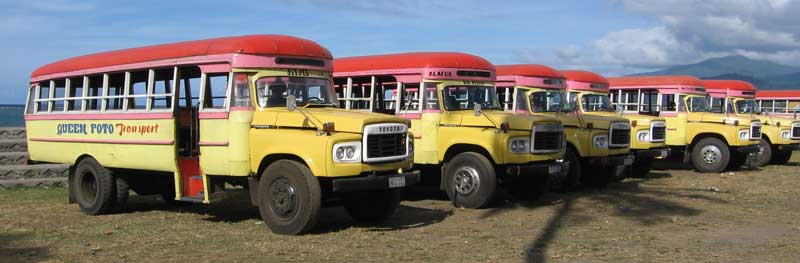
The buses in Samoa are fantastic. A throwback to the old school buses of the United States they make a big impression as you wander the streets of Samoa. There are a small number of companies that operate most of the buses, most notably Queen Poto Transport (pictured here) though many of the operators are individuals, running what may be the single bus that runs to their village.

Whilst the companies like Queen Poto make sure their buses are identical in look, most of the buses feature highly individual designs. Of course I've managed to miss most of these whenever I've had my camera in hand, so the best example I can offer is one of the buses that run to the village of Letogo - the "God Is Good All The Time" bus. Other notable buses include "Queensland - Samoa" and "Poetry in Motion" but my favourite would have to be the "Don't Tell Mum" bus. Apparently the driver's selection in music was so good that schoolkids would stay on the bus instead of getting off and going to school. Their catchcry, "don't tell mum!", now adorns the side of the bus.

The music on the bus is just as important as the way it looks. The buses here are loud. Very loud. I'm able to leave my house at the very last minute in the morning because I can hear the bus coming from a good 200 metres away. If I'm half asleep when you get on the bus, I'll definitely be awake by the time I get off it. The selection is predominantly Samoan but a fair whack of hip hop/r'n'b gets played. Bob Marley is also a favourite.

So what does the interior of a typical bus look like? They're spartan affairs. Hard wooden benches that seat two people line the sides of the bus. Apart from the odd dashboard adornment (see the koala clipped to the top of rear vision mirror?) and the mandatory oversized speakers at the front and rear of the bus, that's about it.

Seating arrangements are very particular on the buses here. There are a raft of unspoken rules that govern who sits where. Typically, women and children tend to sit towards the front of the bus, the men towards the back but as the bus fills up with people, a cramped version of musical chairs gets underway. If an older man or woman, or a person with a young child gets on the bus, one of the younger passengers will instantly offer their seat and move towards the back of the bus. This will continue until there are no spare seats left. Things get fun from that point on.

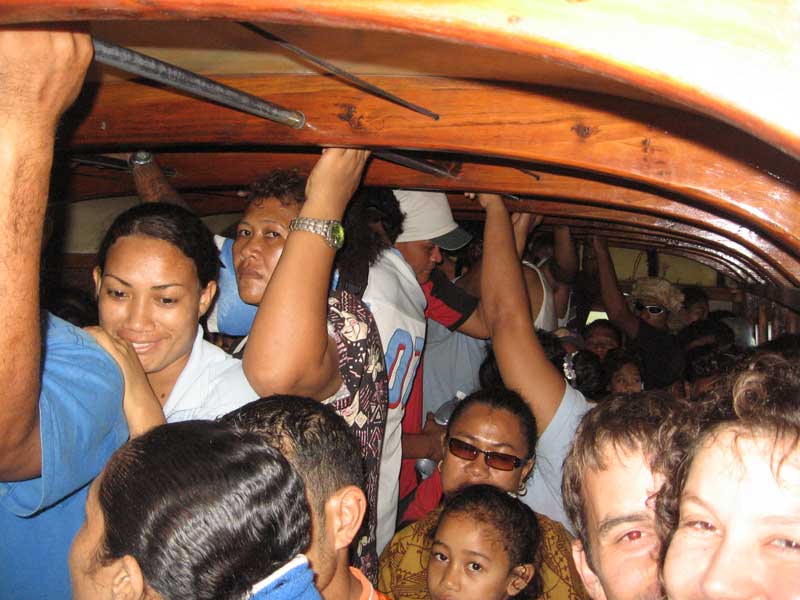
To deal with the lack of seats people will simply sit on the laps of other passengers. In this way, seats that are designed to hold two people end up holding four. People will also stoop in the aisle (the roof is very low) once things really start to get busy.

My village isn't that far out of town so my bus tends not to get too full but a bus trip to the village of Manono-tai (some 40km out of Apia) felt like an unofficial attempt to break a Guinness world record. It was Friday afternoon in peak hour, so there were lots of people heading home for the weekend. Every seat held at least four people. The aisle was full of people, plantains, taro and other essential supplies. It was madness!

Every visitor to Samoa must catch a bus at least once. It's an extraordinary experience and one that is very Samoan. Your bum might be a bit sore from the seat, your ears might ring a little from the loud music but I guarantee you'll hop off the bus with a smile on your face.

Thursday, July 20, 2006

Crazy as a coconut

One of the things I never really gave much thought to before I arrived in Samoa was what little skills I'd pick up here and there. Sure, I was certain to learn aspects of the language but beyond that, what else could I possibly learn?

Plenty as it turns out (unsurprisingly). The least expected however would be learning to obtain free coconuts. In the ten months (!) I've been here I've had ample opportunity to learn how to climb a coconut tree (and climb down as well), how to husk a coconut and how to crack it open to eat or drink its contents. Of course I'm still nowhere near as good at all of this as most Samoans I've met but I have the basics down well enough to guarantee I won't starve if stranded on a tropical island without an alternative food source.

Monday, July 17, 2006

Beach basketball

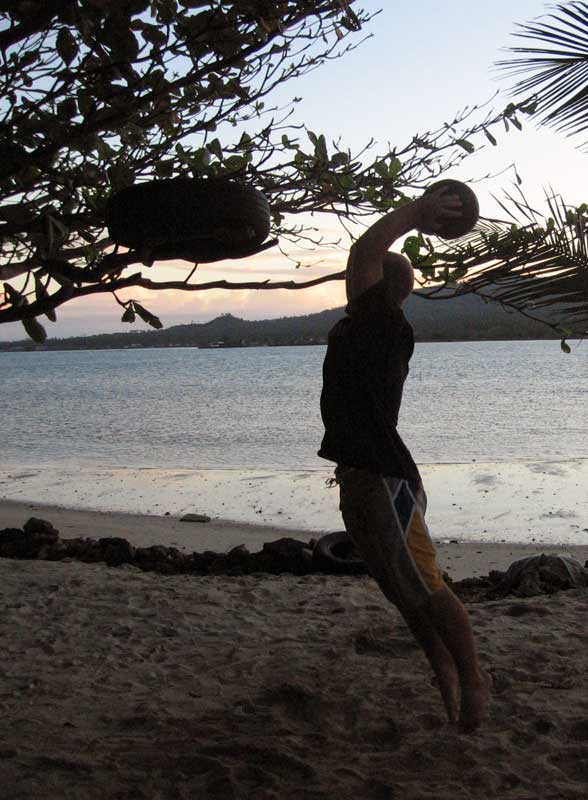
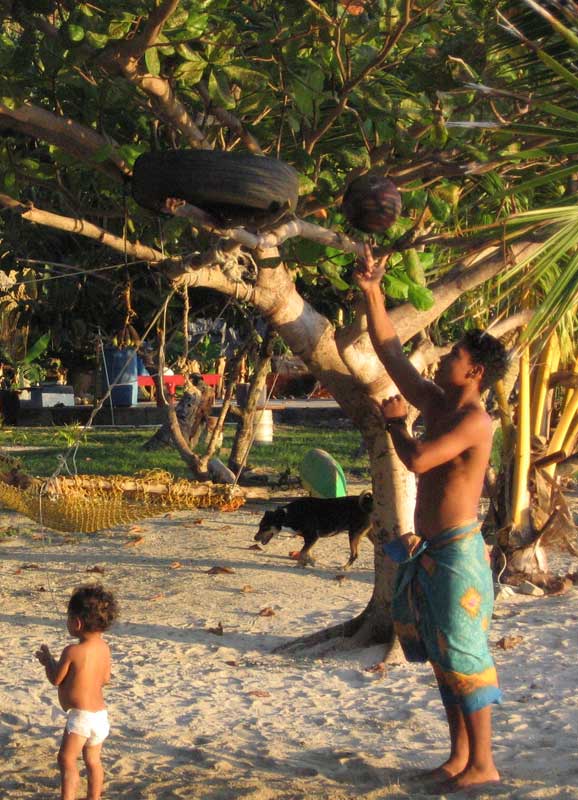
Fellow volunteer Darren and I have just spent the last couple of days on Namua. We needed some time out from our hectic life in Apia and Namua's the perfect place to relax. Whilst there, we spotted a rather sensational basketball ring. Yes, it's a car tire. Bound to a tree branch. On the beach. Perfect playing conditions don't you think?

For a little fella, Darren's got hops. This photo is a rather excellent demonstration of good vertical extension, with the ball held high to make the shot easier. Nice one Darren. Good on you!

Thankfully for some of us, we don't have to rely on a good vertical leap or sound technical skills to make our shots count. Eschewing Darren's excellent technique, one of our hosts on Namua went for the far easier, "I can grab the ring whilst standing flat footed on the beach" approach. I took a similar approach but somehow still managed to stuff things up and make the ball sail over the ring more times than I should have. They do say that practice makes perfect, a mantra that I may use as another reason to head back to Namua again soon.

Manu Samoa vs Auckland PNC

On Saturday Manu Samoa played their one home game of the year against the Auckland NPC squad. Auckland won last year's NPC title and are a quality side full of Super 14 and All Blacks players. Coached by former Manu Samoa captain Pat Lam they've been on the road these last few weeks getting some matches under their belt before the NPC tournament kicks off next week.

It was always going to be a tough match for the Manu Samoa, made harder by the absence of many of their top players. With the international season over for the team, most of the overseas based players were recalled to their clubs. Consequently coach Laulii Michael Jones (himself a former Samoan All Black) looked to local players to make up the squad. Perhaps unsurprisingly, many of the players were selected from the recently successfull Savaii Samoa team that took out the inaugural Pacific Rugby Cup. A few players from the 'Upolu Samoa squad were there too though and Super 14 player Loki Crichton was prominent.

The match was fairly close. Manu Samoa opened up the scoring with a penalty conversion but Auckland struck back with winger David Smith slipping past two defenders to score the first try of the match. The score see-sawed through the rest of the half with Auckland taking a slim 14-13 lead into half time.

Auckland came out much stronger in the second half and played some great rugby. They persisted in attacking the Manu Samoa goal line and were rewarded for their efforts. All Black Jerome Kaino scored his second try of the match to seal the win. The final score: 21-16 in Auckland's favour.

Despite the loss, it's a fairly positive result for Manu Samoa. Michael Jones only had a week or so to put the team together but they played very cohesive rugby. That the majority of the team played together during the Pacific Nations Cup no doubt had a lot to do with it. Also positive was the fact that the match gave a lot of local players their first opportunity to don the national jersey. With the Rugby World Cup just around the corner it was a good chance for Michael Jones to assess the quality of the players available to him and he will, inevitably, need to draw from the pool of players based in Samoa as well as those overseas.

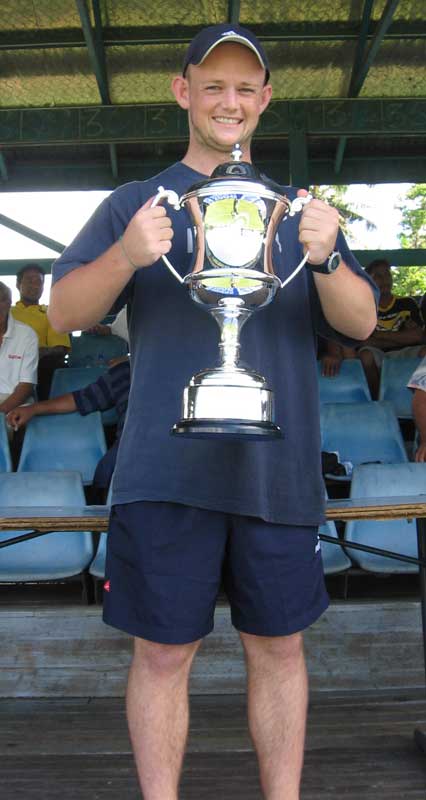
As for us in the stands, we had a great day. We'd splashed out and bought the "corporate" tickets (though I negotiated a discount) and were able to enjoy drinks and nibblies as part of the package. Sure, the bar ran out of beer earlier than we hoped, but we had a great view of the field, the atmosphere was fantastic and we were entertained by some quality rugby. It's just a shame that Manu Samoa only had the one home game this year.

Thursday, July 13, 2006

Should gays be banned?

Last week the Worship Centre Church of Samoa urged the Government of Samoa to consider criminalising and banning gay people from the country. The National Council of Churches General Secretary, Reverend Fepai Kolia, said that whilst they shared the Worship Centre Church's objections to homosexuality, they would not be calling for a ban, as it would transgress the boundary between church and state. This is an interesting comment from the Council, considering how heavily they trampled over that boundary in the case of the censor's banning of the Da Vinci Code. Reverend Kolia went on to state the "the Holy Bible condemnds homosexuality, which is a Western value (emphasis added)". Really?

Samoa has long accepted homosexuality in the form of fa'afafine. This has traditionally meant being effeminite and submitting oneself to a life of domestic responsibility. What Rereverend Kolia really means when he says that homosexuality is a Western value is that he finds the notion of a homosexual person being equal to a heterosexual one foreign. In other words, the idea of a masculine homosexual man is viewed as abnormal and an affront to heterosexuals.

Picking up the story, today's Observer asks, "Should gays be banned?" The people they asked had the following to say:
I think they should. To allow gay relationships in Samoa is like turning our lives back to Sodom and Gomorrah.
Being gay is not right and not normal. It is against our religion and it's evil. It should be banned.
It is a sin and it will bring a curse to this country. We've got to stand up and be vocal about this issue.
It is a sin to be attracted to a person of the same sex and we should not allow it here. We've got to be very careful that our children do not grow up in that kind of environment.

I'd love to see the Observer run a follow-up question asking people if fa'afafine should be banned as well. I think it would be quite a revealing question to ask. In the meantime, I'll have to be content with continuing to ponder the subtleties surrounding these - at times contradictory - understandings of homosexuality.

Wednesday, July 12, 2006

Table Tennis anyone?

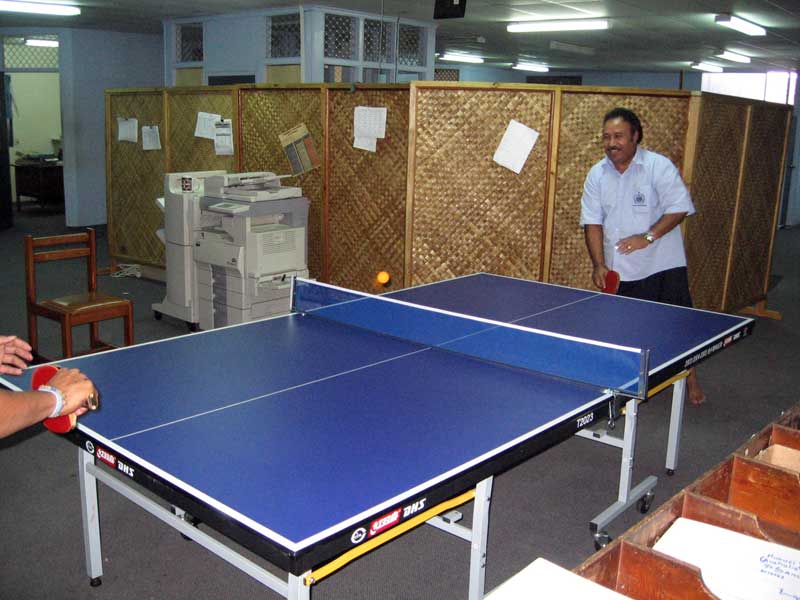
Thanks to our ever-growing friendship with the staff at the Chinese Embassy, we now have a ping pong table in our office. Productivity at work over the last couple of days has plummeted as a result. We've had to resort to locking the net, paddles and balls in a cabinet. We're trying our best to only unlock the cabinet when we've reached the end of our normal working day. We're not quite there yet, though we're getting better with each day. Pictured here is our boss, Fouina, as he prepares to return the serve of another of our staff members (Jacob, left of shot).

Tuesday, July 11, 2006

What's news in Samoa?

It would seem that the hoo-hah surrounding the Da Vinci Code has finally subsided. I think most people are bored of the endless rhetoric and in light of two particular developments, it's pointless to continue. First, the appeal to overturn the ban was declined. That pretty much nails it there. The second reason however, is that everyone now has access to it on dvd anyway. As was predicted at the outset, illegal copies are making their way around town. Arguably it's a win for both sides of the debate.

Far more important than some silly ban however, is the matter of how one acts when nature calls in public places. Moments prior to the kickoff of last weekend's match between the Wallabies and the (Samoan) All Blacks, Jerry Collins felt the urgent need to heed Nature's call. After the completion of the haka, he knelt on the pitch and urinated, using his body and arms to shield himself from view. Nonetheless a camera operator at the stadium managed to catch it all on tape. Class.

Being Samoan, Jerry has received lots of support from Samoans, as evidenced in the newspaper over the last two days. The best line however would have to come from New Zealand website stuff.co.nz:
In my opinion if he keeps playing the way he does he can piss wherever he wants.
Indeed.

The only other news to really hit the pages recently is that of the impending home match between the Manu Samoa and the Auckland NPC squad. The NPC tournament in New Zealand is the feeder comp for the Super 14 and the Auckland squad is full of talent. The Manu Samoa return after two wins on the road (against Tonga in Gosford and against the Western Force in Perth) and are keen to notch up a win on home turf. It would seem however, that the squad will be comprised largely of local players, as the European clubs have already demanded the release of their contracted players. For the most part this seems to be taken in a very positive light. Much is made of the fact that the majority of the Manu Samoa players are based overseas. Any opportunity for local players to get a run in the blue uniform is always heralded as a "Good Thing". I guess we'll know how much of a good thing it is after the final whistle blows on Saturday.

Tuesday, July 04, 2006

A Commission of Enquiry

If T. Aitu's letter in today's Observer is anything to go by, the (HRPP) Government's Commission of Enquiry into the Electoral Act 1963 runs the risk of being discredited even before it makes any official recommendations. The Commission is comprised of ten individuals, of whom
six members were all unsuccessful HRPP candidates in the recent...elections. This means 60% of the Commission are HRPP, 20% are part of Government and HRPP employed and only 20% are non-HRPP.
This isn't exactly the kind of balance one would hope to find in such enquiries. I haven't seen the Terms of Reference for the Commission, so can't comment on whether the whole process has been crippled in a way similar to how the Australian government established the AWB Commission of Enquiry currently underway in Australia. I'd love to see what kind of recommendations it will be able to make.

I'm not suggesting for a second that the enquiry is a complete loss. I've had informal discussions with members of the legal community in the last few days who assured me that there are provisions within the Act that do need to be reviewed. Recent electoral experience has also highlighted a need to review the processes that are used to vette voters' identities, etc. With the membership of the Commission so heavily stacked in the HRPP's favour however, it is hard to imagine a thorough examination of the recent allegations of bribery. We'll wait and see.

Sunday, July 02, 2006

Lake Lanotoo

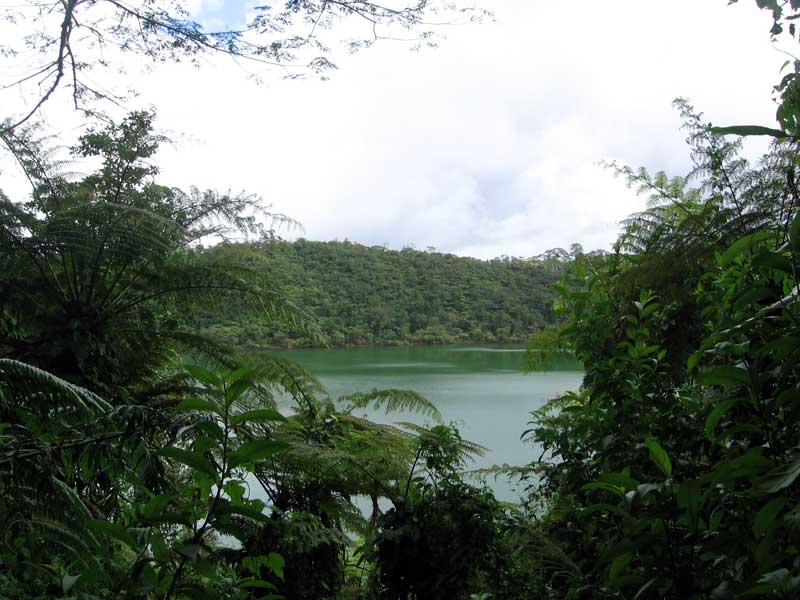
As its name suggests, Cross Island Rd connects one side of the island to the other. It's the fastest way to make it across to the southern coast and the multitude of beaches and hideaways on it. Along the way however are dotted a number of sites of interest. Robert Louis Stevenson's old house Vailima, Papapapai-tai waterfall (say that three times quickly!), the Baha'i temple and Lake Lanoto'o are all found along the road. Today I travelled to Lake Lanoto'o.

Lako Lanoto'o is a pea-green body of water in the crater of an extinct volcano in the middle of the 'Upolu highlands. It's a fair way off the beaten track however; after our taxi deposited us a few kilometres down the off-road from Cross Island Rd, we spent the next hour and twenty minutes hiking through lush tropical jungle to the lake.

Whilst we didn't have a guide, it's not that hard to find the way. First you pass the paddock full of cows. Keep that to your left as you go and pay attention so as to avoid the occasional cow pat that marks the way. Eventually you'll reach a fairly high wall of dense foliage. A small sign tells you that's where you need to go.

The track gets a little muddy here and steep quite rapidly. It's advised that you have long pants and good shoes for the hike but a couple of us managed with thongs today. If it had been raining, I'd have definitely worn shoes. Your mileage may vary.

Pick your way along the track and gradually ascend the mountain ridge. You'll eventually reach a part of the track that provides a pretty spectacular view north-north-west out towards the ocean. Don't rest here though because you're not even halfway to the lake. Keep climbing!

You know you're almost there when you stumble across the crumpled remains of a telecommunications tower. The tower is situated on the eastern ridge of the crater. The track heads downwards pretty quickly and as you make your way, you're afforded your first peek at the lake. It really is pea-green!

Once we arrived it didn't take long before we were in the water. You'll be in the drink in a flash too. The water's definitely cool but not freezing cold. Look underwater and it's a lush green colour, deepening in tone as the lake's bottom drops away. It's very refreshing and very necessary; the hike through the jungle will leave you sweaty and dirty.

We stayed at the lake for just about an hour before we turned around and made our way back to Cross Island Rd. Along the way I snapped a few more photos, including this one of some moss on the side of a tree. It's such lush jungle.

We called our cab driver on our way back (there's mobile phone coverage for much of the hike) who was waiting for us at the end of the dirt road. A quick stop in at a supermarket on the way home for an ice cream capped off a fantastic day's trekking. It's a bit out of the way but Lake Lanoto'o is definitely recommended!

A great park

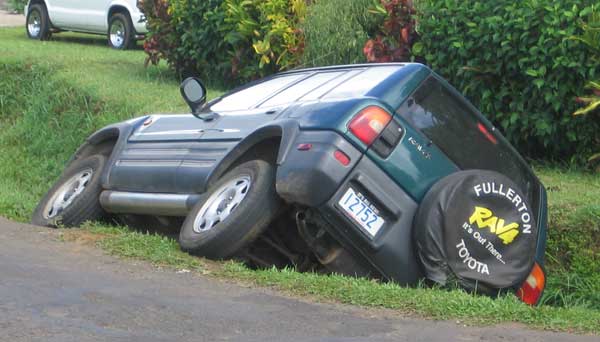
I just spotted this sensational bit of parking in the neighbouring village of Vaivase-uta. Full marks for effort but none for execution I'm afraid. Even I park better than this!