Tuesday, January 31, 2006

Still life with mullet


A few weeks ago at the annual Pua'a festival, I stumbled across this. I have refrained from posting about the (abundant numbers of) mullets here in Samoa for some time, but this is such a good photo I couldn't hold back any longer.

Savaii - Olemoe waterfall


Tucked away in the southern interior of Savaii is Olemoe waterfall (I believe also known as Afu Aau). It's a couple of kilometres off the main road and really only accessible by foot or in a 4WD but it's well worth the visit. Careful navigation of a steep, muddy trail and rickety old ladder is necessary if you want to swim.

Some twenty or so metres high, the waterfall falls into a crystal clear freshwater pool. The pool is quite deep, reaching seven metres depth in some places, and is wonderfully refreshing to swim in. The rock walls of the ravine stretch up high into the sky, covered in rich, dense plantlife. Lichens and moss at the bottom give way to ferns, which in turn are replaced by trees and vines towards the top. On all sides the pool is surrounded by thick tropical jungle.

If you do swim in the pool you'll discover that you're not alone. Freshwater prawns and yabbies inhabit are abundant; sit still long enough on the water's edge and you'll feel them occasionally nip at your toes.

It's a truly beautiful place and so secluded you very quickly forget the rest of the world.

Savaii - Lava flows


The islands of Samoa are volcanic in origin; dormant and extinct volcanoes exist on each of the major islands that constitute the Samoa archipelago (Samoa and American Samoa further to the east). The presence of these volcanoes is no more evident than on Savaii, the second of the two large islands that constitute Samoa.

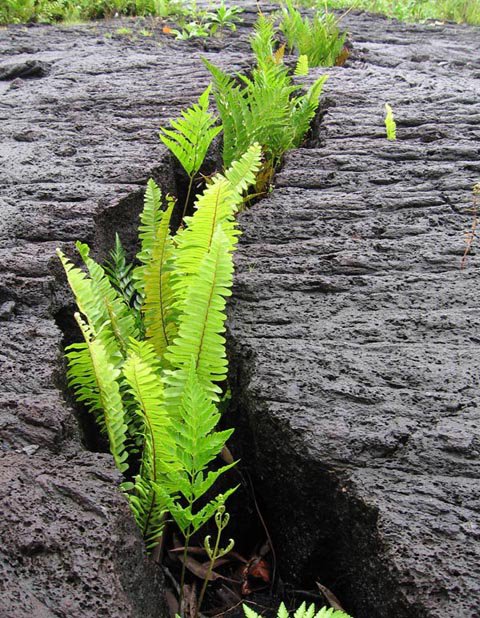
Large swathes of Savaii are covered in lava flows, the remnants of a slow eruption from two volcanic mountains that took place from 1905 until 1911. Driving along the eastern coastal road of Savaii reveals large tracts of land where the lava dominates the landscape. Dark black lava (andesite or basalt perhaps? Rock nerds let me know), showing the effects of its slow flow across the landscape, stretches across the horizon. Large sections are rippled, and long fractures streak through it all.

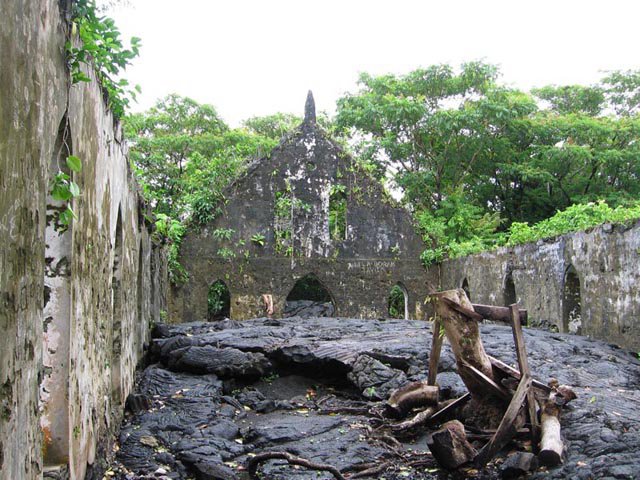
Most interesting of all are the places where the lava met, and consumed, areas of human habitation. In one area on the eastern coast, three churches were destroyed by the lava flow yet still stand. The London Missionary Service (LMS) church, pictured here, is amazing. The lava filled about half of the building, slowly pouring through its main entrance. Impressions remain where the corrugated iron roofing collapsed onto the lava.

Thursday, January 26, 2006

Manuia le Aso Ausetalia

My apologies, I don't know how to say "Happy Invasion Day" in Samoan yet. Still have much to learn.

Regardless, a few of us kicked off the celebrations on what is, technically, a day early. We took the afternoon off work to head home and listen to Triple J's Hottest 100 broadcast over the Internet. We had sausages and onions on pieces of bread with sauce, Caramello Koalas, etc., and generally had a good time. Not too sure I agree with Bernard Fanning earning the No. 1 spot though. Rubbish.

Still, a good time was had by all and the best bit is, tomorrow we get to celebrate it all over again. All the Australians the High Commission has been able to hunt down have been invited to an official reception tomorrow (Jan 26th) evening. A friend and I will also be throwing an Australia Day bbq at work tomorrow too.

Sometimes living in the last place on earth has its advantages. ;)

What's in a name?

In Samoa, anything and everything. I've never come across a culture so ready to embrace the unusual, or more plainly the "other", when it comes to names. They truly take the idea of loan words to new heights. Some rippers that have come my way lately include:

Oceanbaby
Czarina
Comeboy Michael
Miracle
Raumahinatehinemahora
Ausetalia (Australia)
Census Johnson (a great Samoan rugby player)
Kingcup
Ofisa Ofisa
Komiti Komiti
Fa'afetai (thankyou)

Unfortunately I've misplaced the best/most astonishing name I've come across yet. I'll do my best to hunt it down and add it to this list.

Monday, January 23, 2006

Cops play pops


Every weekday morning, just before 8am, Beach Rd comes to a standstill as the Samoa Police band makes its way to the Government building for the raising of the national flag. On the way they perform several traditional marching band numbers as the cars idle slowly behind them. As the flag is raised they play the Samoan national anthem and all traffic comes to a standstill.

As a friend noted this morning, it's an interesting little piece of Colonial history that the Samoans embraced as their own. The officers wearing skirts does give it a decidedly Samoan character.

Friday, January 13, 2006

Tropical cyclones Tam & Urmil


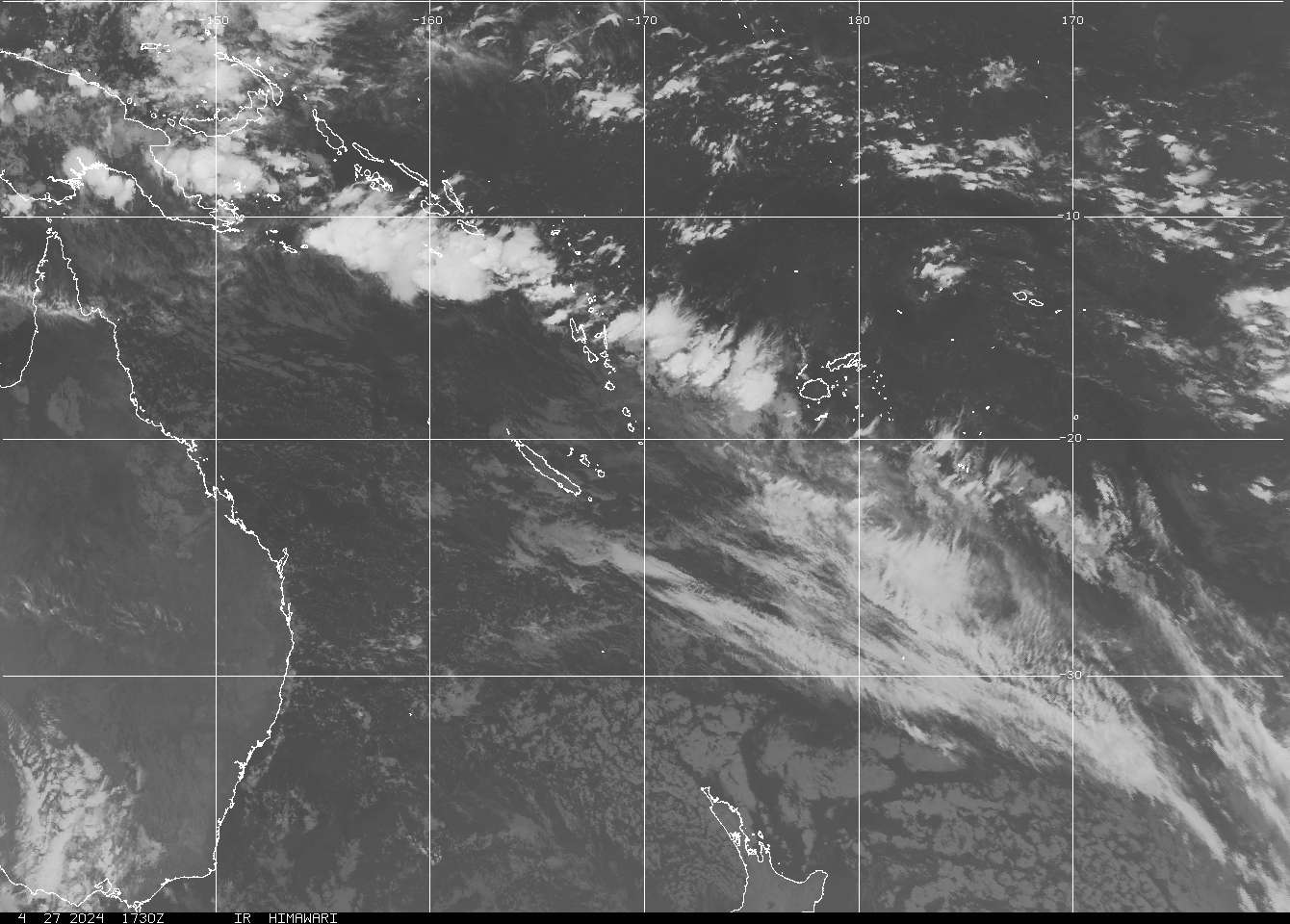
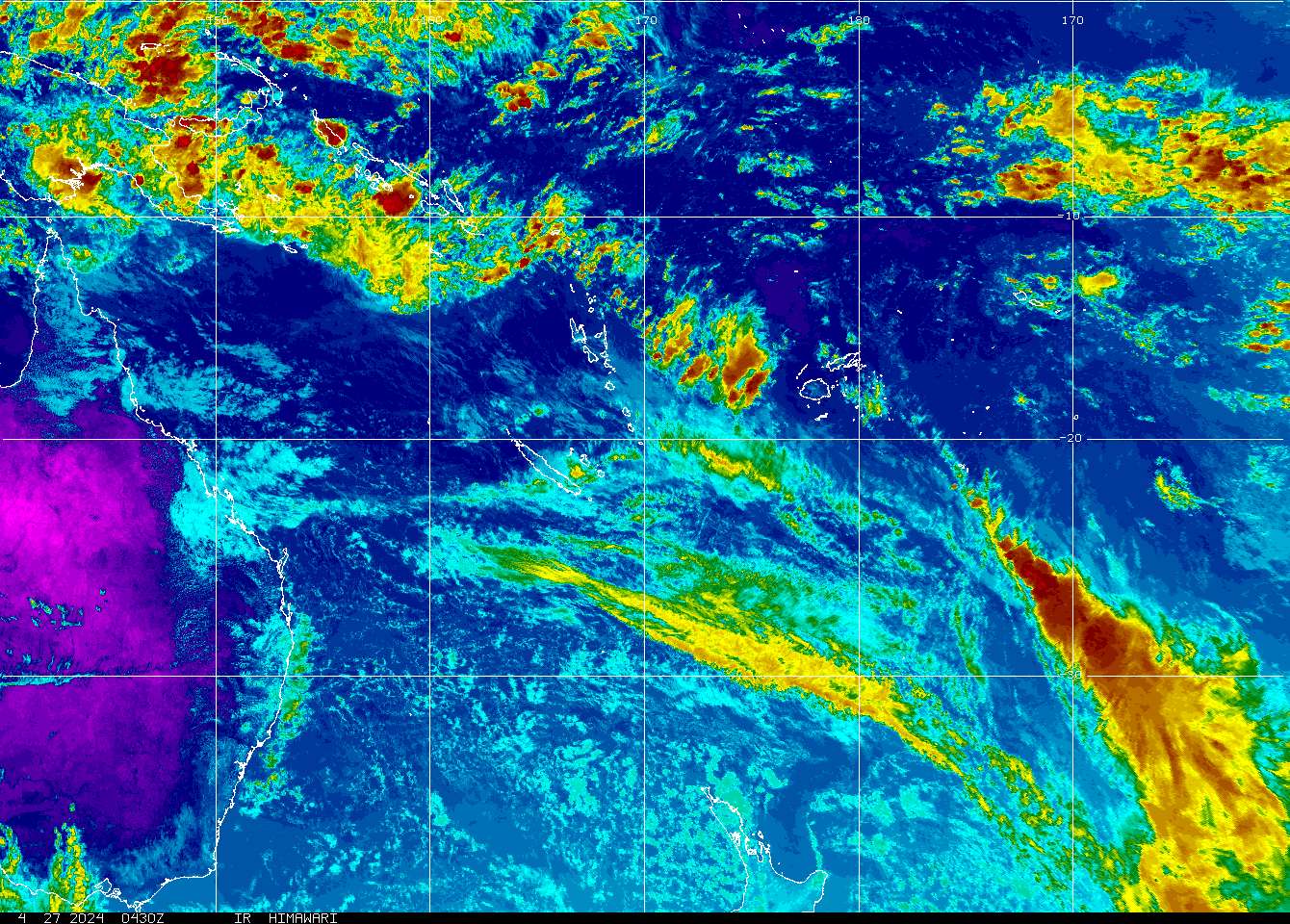
The first cyclones of the season have formed not too far south-west of Samoa. Lucky for us (though perhaps not so lucky for those in Tonga, Niue and Wallis & Futuna) it looks like they should pass us by.

Over the last few days it's been easy to tell that something big has been brewing. It's been raining solidly for at least three days now, and the wind has been gusting harder and harder. This morning on the way to work I saw a couple of coconut trees that had snapped in half overnight. Low-lying areas have suffered some minor to moderate flooding too. At the end of the day though, we're suffering nothing more than rubbish weather. I'm sure Melbournians put up with this kind of thing all the time. ;)

The US National Oceanic & Atmospheric Administration posts visible and infrared spectrum satellite images of the region on their website. If you have Java, you can even look at some of their satellite image loops. The image above is cropped from the coloured infrared snapshot taken at 6.30pm UMT on the 13th. You can see the outline of Samoa's two islands just above and to the right of the centre of cyclone Urmil. The Fijian island chain is in the clear to the left. Tonga, rather unfortunately, is a small white speck in the main part of the cyclone. Tropical cyclone Tam is just off the bottom of the image.

Thursday, January 05, 2006

Sunset in Samoa

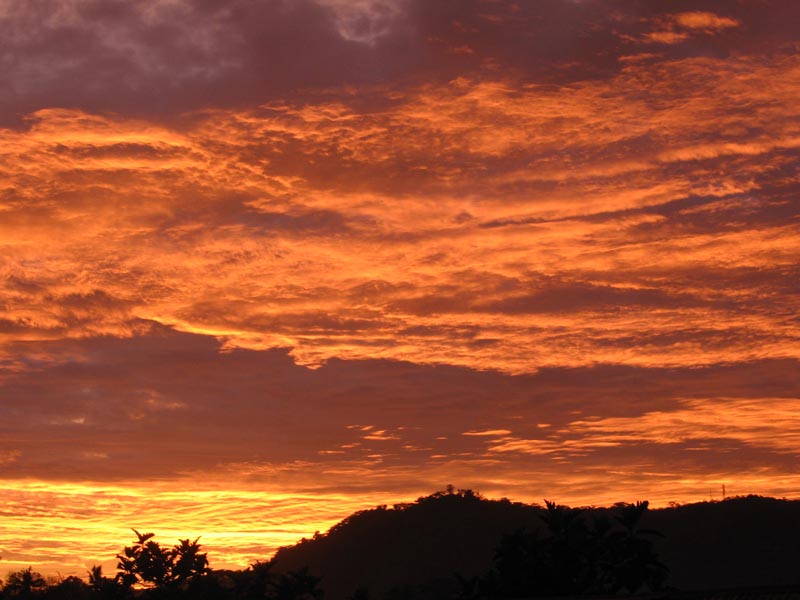
This is what sunset looks like in Samoa. I took this photo just outside of my house this afternoon.

Living like hermits (continued)

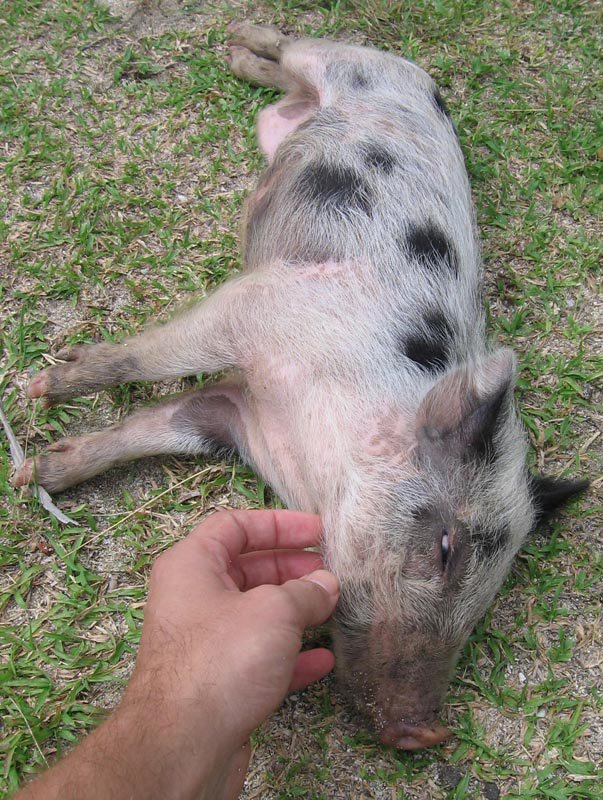
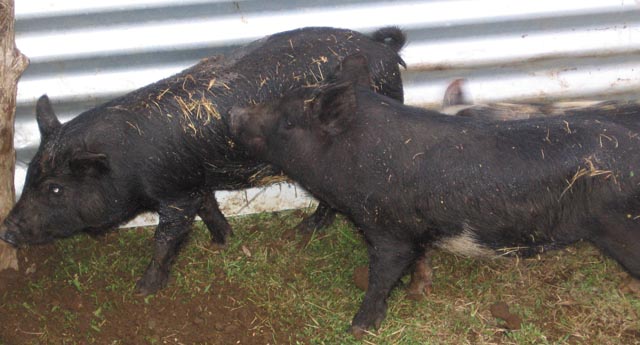
Say hello to the most domesticated pig in Samoa. A resident of Namu'a, she kept us company (or perhaps occasionally demanded it) during our stay. She particularly liked scratches under her chin and behind her ear.

Living like hermits


After a particularly long (but definitely enjoyable!) Christmas Day, I managed to get out of town for a couple of days with a couple of friends. We were able to escape to the comparative calm and quiet of Namu'a island, a small island off the south-east point of 'Upolu (the main island of Samoa, the other large island being Savaii). With just a single beach (really just a splash of sand) and a handful of fales sitting just behind it, Namu'a is tiny. It's the perfect place to go and hide from the rest of the world.

The waters around Namu'a are a popular feeding ground for sea turtles. On the boat over to the island we spotted a giant one, gliding effortlessly and gracefully through the crystal clear water. Very amazing.

Whilst there, I can safely say all I managed to do was go snorkeling, eat the occasional meal and sleep. Oh, that and meet the most domesticated pig I've encountered in Samoa.

Thursday, December 22, 2005

A beginner's guide to pua'a


Pua'a - pig - is an institution in Samoa. Spend any time here and you will inevitably encounter, in one form or another, plenty of them. It is a far cry from Australia, where we typically only see pigs at the butchers or supermarket. Since my arrival three months ago, I have learnt the following about pua’a:

1. Pua'a are valuable
Never underestimate the importance of a pig. They provide hours of fun for the family and, assuming your sow gets stitched up on a regular basis, represent an almost endless supply of food. When required to donate something for a fa’alavelave - a major event such as a funeral or wedding - handing over a pig or two can go a long way. And it's cheaper than the financial alternative.

2. Pua'a are everywhere
Since they are so valuable, everyone owns pua’a. Lots of them. They're everywhere. Sows and their litter can be seen wandering through villages, relaxing by family graves and regularly trotting along and across the road. You always need to keep an eye out when driving.

3. "That's not a speed hump you just drove over!”
Eventually you're going to run over a pig. A split second before it happens you feel like a pig shooter in outback Australia, running down wild boar caught in your spotlights, but that feeling evaporates the moment you watch it disappear from view only to feel a couple of large thumps as your car drives over it.Running over a pig isn't really considered kosher (but then neither is pig) so it's advisable to do one of two things: keep on driving and pretend it never happened, or (if you're seen hitting the pig) offer adequate financial compensation to the owner. Occasionally a third option opens itself up to the savvy driver, which can be summed up as...

4. Never look a gift pig in the mouth
Typically, as a palagi living in Samoa, you’re only going to be offered pig as part of a meal. Should you bring an early end to a pig’s life though, you might not want to pass up the opportunity of a free feed. See point six below. Should you actually be lucky enough to be given a live pig, well then you have options open to you.

5. "Greasing the pig"
I mentioned above that pigs provide hours of fun and I wasn't lying. At the recent "Puaa Fest" I was pleased to discover that, at least in Samoa, the phrase "Greasing the pig" isn't just a euphemism. Sure, it's something that young boys primarily engage in, but the girls get into it too. Maybe it could catch on abroad, as it's very simple to arrange:

  • Use some spare tin roofing or similar to build an enclosure (4m x 10m should do).
  • Stick a couple of your smaller pigs in the enclosure.
  • Grease your pigs - two or three sets of hands are really required for this step as you want to make sure the whole pig is slippery with grease.
  • Watch the smiles on the kids' faces as they attempt to catch, barehanded, your greased pigs. Delight in the sounds of pure animal fear as the pigs attempt to evade capture.
Note: It’s probably advisable to have a medical kit on hand as sometimes the pigs do bite. Should this happen, attend to wounded child then consider the next point for dealing with your pig.

6. Cooking and eating your pua'a
The best option for enjoying your pig is, without doubt, to eat it. The idea is to stuff it full of hot rocks wrapped in mango and breadfruit leaves, make it the centrepiece of your umu oven and enjoy it about an hour or so later. When preparing your pig, it is always important to place one hot rock in the throat, one in the stomach, and another someplace you usually hear John Elliot talk about to make sure that the meat is cooked through. Serve with umu-cooked taro and palusami for a fantastic meal.

It's what I'm doing for Christmas.

Saturday, December 10, 2005

Roosters can't tell the time

My neighbours obtained a rooster at the beginning of the week. I know this because every morning, several times between 2am and 5am, the damn thing crows its head off. So much for the idyllic picture of roosters crowing to welcome the sun as it rises above the horizon.


Is it too early for a Christmas roast?

Monday, November 28, 2005

More Palolo


The second (November) rising of palolo has occured in the last few days. You can tell because it's back on the specials menu at several restaurants & cafes around Apia. Palolo on toast for $10WST has been the best deal I've seen thus far.

The photo is of Salamumu beach just as the sun begins to rise. Everyone is starting to head back to shore and make their way home to enjoy their catch for breakfast.

Sunday, November 27, 2005

Palolo Rising


The palolo worm is a segmented marine coral worm (within the polychaete class for you marine biology nerds), related to the earthworm. It's apparently found across most, if not all, of the South Pacific islands, living about three or four metres underwater, occupying the crevices of coral reefs. The worms are usually five to eight centimetres long and are pink-brown or blue-green coloured.

In both October and November, typically on the day before and the day of the last quarter moon, the palolo spawn. Each worm crawls backward out of its hole. The back part of its body breaks off and wriggles to the surface of the sea, then the front end returns to the burrow to
grow a new hind part. Meanwhile, at the water's surface, the brownish males and blue-green females discharge their sperm and eggs, respectively, beginning a new generation of palolo worms. In short, it's a massive worm orgy.

For Samoans, the palolo is considered quite the delicacy. Thousands of people flock to beaches across the Samoan islands in the early hours of the morning to catch as much of it as they possibly can. On Sunday night/Monday morning, armed with nets, sieves, buckets and torches, a handful of Australians joined the hunt.

We left home at midnight and drove for an hour or so to Salamumu, a beach on the southern side of the island, where we spent a few hours lying on the beach looking up at the stars (wow!) and checking for signs of the palolo. At roughly 4am, the palolo was spotted and we joined a couple of hundred people (at our beach) in the water to catch the worms. When we started it was still pitch black, but the flickering of torches in the water could be seen for kilometres down the coast. It was an incredible thing to see. I can't begin to put it into words.

With the aid of our torches, we spotted (and netted) countless blue-green and brown worms, squirming around just under the surface of the water. They were everywhere! We had a lot of fun, but for many of the Samoans nearby it was a serious task. Once they rise, there is not a lot of time to catch the palolo, as they disintegrate in the morning sun. Every minute counts. We continued until about 5.30am when the sun started to rise. Several people nearby were very curious to see how many palolo the palagis had managed to catch. I don't think we did too badly; we certainly had enough for all of us to try.

Palolo is traditionally eaten alive, fried in butter or baked in breadfruit leaves in an umu. Not having an umu handy, the best we could do was fry it in butter. I ate a few live ones, but I suspect I'd have to eat a small handful to really get a sense of the "raw" taste. We chose to cook the palolo in butter and spread it on toast (kind of like pate). Within seconds of the worms hitting the heated pan, they turned into a blue-green mush. Certainly not the most attractive sight you've seen. Spread across toast it didn't look that much better (as shown in the image).

It didn't taste too bad, but then again, to our uneducated palettes, it didn't taste too much of anything. Maybe I stuffed up in the cooking. Yesterday at work I managed to have some palolo that had been baked in an umu. It tasted great, most similar to the taste of mussels. It made me begin to see why the Samoans consider it such a delicacy.
White Sunday


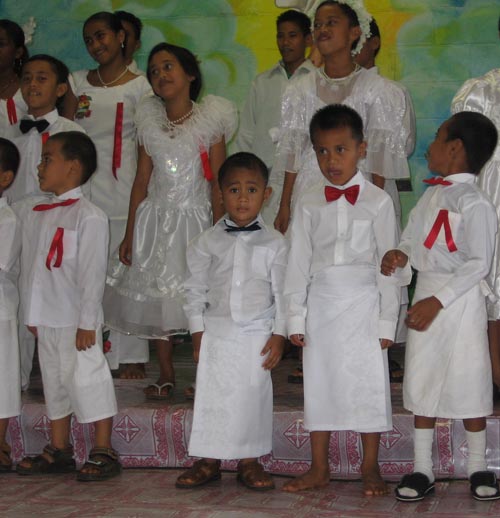
Every October in Samoa sees the celebration of White Sunday. Started (I think) by the Methodist church maybe seventy years ago, and picked up by the other denominations in short order, it's like a Christian version of Father's/Mother's Day for children. For one day of the year they are accorded (a degree of) the respect and deference normally shown towards one's elders (such as being served food before anyone else). They all dress in white clothes, wear ribbons in their hair or pinned to their shirts and are showered with gifts such as toys, new shoes, clothes or the crowd favourite: ice cream.

More importantly, the children play a major role in the morning service in church. They sing songs of praise, perform skits relating parables from the bible and, as occured during the service I attended, share the responsibility of delivering the sermon to the congregation with the pastor. In the pastor's words, "it's important that the adults hear the word of God from the mouth of (their) babes."

To say it was a wonderfully colourful and vibrant event is a bit of an understatement. The songs were loud and upbeat, the skits numerous and (whilst delivering a serious message) light-hearted, and the childrens' sermons delivered with a fervour you normally see on television at 5am when you're suffering insomnia. It was quite the experience.

At the service I attended, I and two other Australian volunteers were guests of the pastor's daughter. As such we were accorded a degree of respect (and attention) I don't think we were quite ready for. We were given the best seats in the church for the service and were invited to join the pastor and his family for lunch afterwards. As the pastor provides spiritual nourishment to his flock, they provide material nourishment. Members of the congregation brought plates of food to their house after the service. Most of the food had been cooked in umu ovens (to the best of my knowledge the only above ground traditional oven throughout Polynesia and Melanesia). Taro, breadfruit, palusami, a couple of whole chickens, sides of pork and mullet, beef soup and oka (a coconut milk-based ceviche style dish with big chunks of fresh tuna) graced our table. Yummy stuff.

Tuesday, October 11, 2005

Talofa lava!

Talofa!

Welcome to Mr Lavalava, where I'll be posting my account of life in Samoa. I've just begun a twelve month placement in the Samoan Ministry of Prime Minister and Cabinet as part of the Australian Youth Ambassador for Development program. Whilst this work will, understandably, dominate my time here, it's not what I want to be the focus of this blog. Instead, I wish to focus on fa'a Samoa - the Samoan way of life - and my experience of it. The updates might be a little infrequent to start with as I get myself established, but will hopefully become more regular in a few weeks.

Cheers!