Hot on the heels of Samoa's decision to ban the Da Vinci Code from video and television screening and video and dvd rental comes news that both the Phillipines and the Solomon Islands have followed suit. It seems this is an issue that's picking up steam throughout strongly Christian countries.
I don't really know anything about the situation in either country but I do know that the decision here has provoked a remarkable amount of dissatisfaction. Today's Observer has a full four pages of letters regarding the ban and all but one or two of them are negative. In the eight months I've been here I've not once seen this much page space devoted to letters (we're normally talking about half a page at best). Most of the letters boil down to the following question: does the Council of Churches worry so much about the strength of faith of Samoans that it has to ban a movie that is clearly a piece of fiction?
Whether or not the censor reverses the decision I suspect will be irrelevant. The movie will find its way here. The fact that easily 95% of all dvds for rental here are illegal copies in the first instance confirms that. The real question is how the Council of Churches acts. I'll keep you posted.
Tuesday, May 23, 2006


Sunday, May 21, 2006
Censors: 1; Crap film based on crap book: 0
"Huzzah the censors!" Words I'd never expect to hear come from my mouth but today I utter them with glee. After a preview screening to leaders of the Samoa Council of Churches, the Samoan government's principal censor has banned The Da Vinci Code from cinema, dvd and video rental and television broadcast. Result!
I've made the mistake of reading two of Dan Brown's books but have steadfastly refused to go anywhere near The Da Vinci Code. If you want to read a compelling, absorbing, intelligent and at times quite humourous book that looks at Christian conspiracy theories (and a whole lot more), please do yourself a favour and read Umberto Eco's Foucault's Pendulum.
The upshot of the censor's decision is that the one cinema in Samoa now has more time in its schedule to screen its three other current offerings. Thank goodness. Just what everyone needs. More time for Poseidon, The Sentinel and Mission: Impossible III.
I've made the mistake of reading two of Dan Brown's books but have steadfastly refused to go anywhere near The Da Vinci Code. If you want to read a compelling, absorbing, intelligent and at times quite humourous book that looks at Christian conspiracy theories (and a whole lot more), please do yourself a favour and read Umberto Eco's Foucault's Pendulum.
The upshot of the censor's decision is that the one cinema in Samoa now has more time in its schedule to screen its three other current offerings. Thank goodness. Just what everyone needs. More time for Poseidon, The Sentinel and Mission: Impossible III.
The inaugural IRB Pacific Rugby Cup
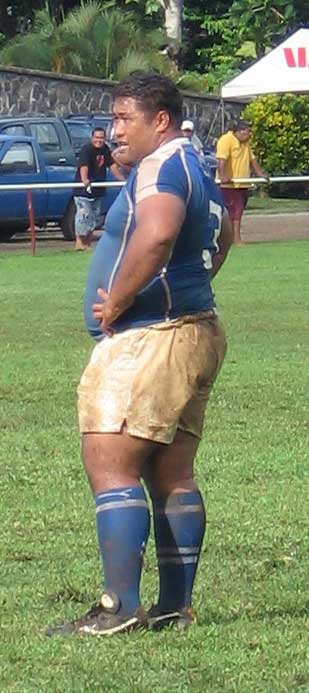 In an effort to help lift the performance of the Pacific rugby nations, the IRB last year announced two major regional initiatives. The more important of the two is the creation of High Performance Units for Fiji, Samoa and Tonga. The other is the creation of an annual Pacific Rugby Cup. tournament The tournament is designed with providing locally based players greater opportunity to play competitively at a high level. Importantly, it provides these local players (who come in all shapes and sizes as evidenced here) a chance to train, travel and play rugby in a fashion very similar to that of the touring international squads.
The tournament is comprised of six teams, two each from Fiji, Samoa and Tonga. Over the last six weeks these teams have played each other at home and away in the pool matches with some firce competition between several of the sides. The last pool round was particularly crucial for establishing where the home final would be played. Thanks to Savaii Samoa's win over 'Upolu Samoa in that round, the final was held yesterday at the Marist grounds at Lotopa. Savaii Samoa playing against the Fiji Warriors to earn the right to lift the Pacific Rugby Cup.
 The standard of play during yesterday's final was not brilliant but one has to take into account the heavy rain earlier in the day that made for tough going. Evenly matched in the first half, it was only until the second half that the intensity of the game really picked up. An excellent period of rugby by Savaii Samoa saw them cement their first half lead over the tourists, who to their credit, applied enormous pressure in the final fifteen minutes of the match. Spirited defense however kept them from scoring, giving Savaii Samoa a hard earned 10-5 win.
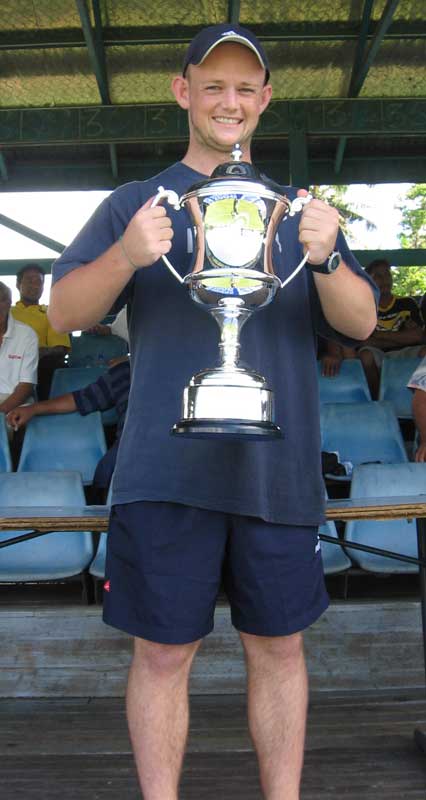 The win gives the Samoa Rugby Union its second trophy to keep in the cabinet alongside the Pacific Tri-nations Cup they won last year. The trophy is a pretty nice piece of silverware, modelled rather well by my mate Darren, as one can see in the accompanying photo. For the players however, the cup itself may well pale in comparison to the possibility of being called up to join the national squad. With Manu Samoa coach Lauli'i Michael Jones watching yesterday's final, many were keen to show their skills in the hope of representing their country in next month's Pacific Five Nations tournament. We'll have to wait and see.
Wednesday, May 17, 2006
Paddling
Every Wednesday afternoon a group of us get together to go paddling. It's a wonderful way to unwind after a day's work. The temperature is usually nice and mild and being on Apia harbour offers a truly beautiful vantage point of the city as the sun sets. I love it.
With my leg still healing, I've had to stay out of the boat these last few weeks. It's tough, but sitting on the sea wall watching my friends make their way across the harbour is still a fantastic way to pass the time. This afternoon was no exception.
 Of course, ours is never the only boat on the harbour. A fautasi crew has been practising several times a week over the last month or so, no doubt in preparation for next month's Independence Day celebrations. Getting forty or so people onto the fautasi takes a bit of time and effort but once they're all set to go it's well worth it.
 The sight and sound of a fautasi on the water is remarkable. Once they get going they move at a rapid pace. They have people at each end of the boat supervising the stroke count and generally urging the rowers to keep going. To help them in their task, a crew member knocks out a regular, up-tempo rhythm on a drum. I'm very much looking forward to next month's Independence Day fautasi race when we can expect to see numerous fautasis on the water.
 Compared to the fautasi and its crew, we don't look quite as impressive (but it does take a lot quicker to get going). The canoes we use hold six people. The lead position is known as the "stroke". Whoever sits there is responsible for setting the pace. They're also responsible for notifying the rest of the crew as to when they should switch the paddle from one side of the boat to the other. We tend to switch sides once every twelve or so strokes. That way you don't feel like your arm is going to fall off. The person at the end of the canoe is the "steer" and, well, I'm sure you can figure out what they do.
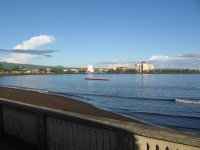
 As I sat on the sea wall this afternoon and watched my friends make their way around the harbour - up along the wharf (shown here) to down near Aggie Grey's Hotel - I realised that this will be one of the things about Samoa I miss the most. I love being on or near the water and Apia harbour is no exception. The view back towards the island is beautiful and, as I mentioned before, watching the sun set from a canoe is truly wonderful.
I'm hoping my leg will have healed enough next week to allow me to get back into the boat (I'm quite confident it will). With less than five months left in Samoa I'm starting to feel a sense of urgency; I should make every effort to turn up for paddling every week. I don't want to miss what remaining chances I have to see a sunset like this:
 Wouldn't you agree?
With my leg still healing, I've had to stay out of the boat these last few weeks. It's tough, but sitting on the sea wall watching my friends make their way across the harbour is still a fantastic way to pass the time. This afternoon was no exception.
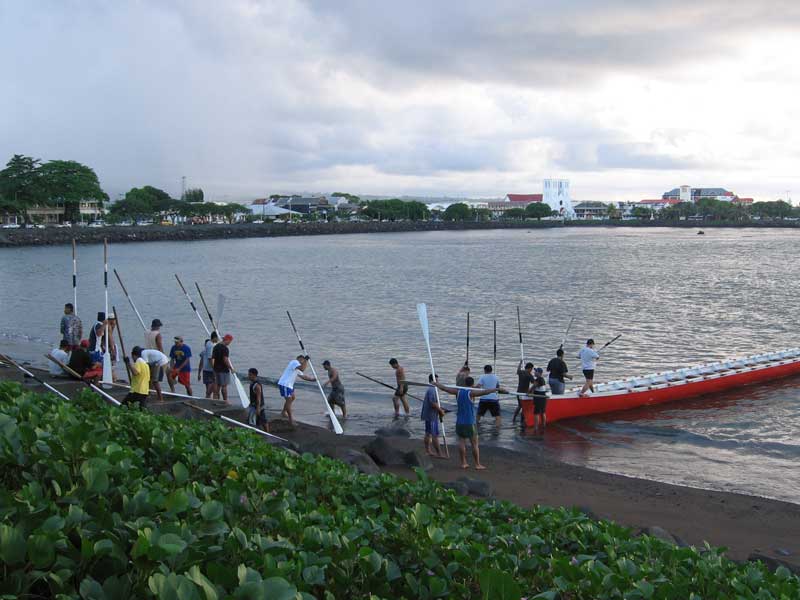 Of course, ours is never the only boat on the harbour. A fautasi crew has been practising several times a week over the last month or so, no doubt in preparation for next month's Independence Day celebrations. Getting forty or so people onto the fautasi takes a bit of time and effort but once they're all set to go it's well worth it.
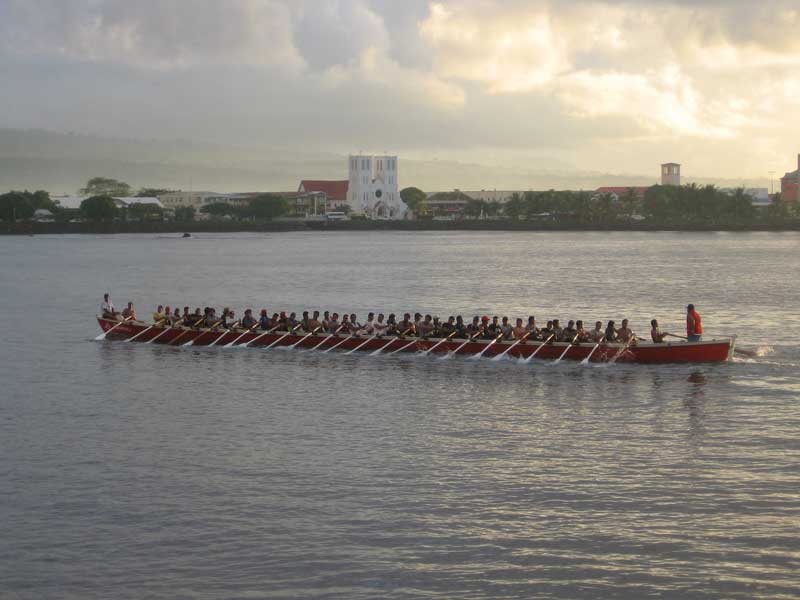 The sight and sound of a fautasi on the water is remarkable. Once they get going they move at a rapid pace. They have people at each end of the boat supervising the stroke count and generally urging the rowers to keep going. To help them in their task, a crew member knocks out a regular, up-tempo rhythm on a drum. I'm very much looking forward to next month's Independence Day fautasi race when we can expect to see numerous fautasis on the water.
 Compared to the fautasi and its crew, we don't look quite as impressive (but it does take a lot quicker to get going). The canoes we use hold six people. The lead position is known as the "stroke". Whoever sits there is responsible for setting the pace. They're also responsible for notifying the rest of the crew as to when they should switch the paddle from one side of the boat to the other. We tend to switch sides once every twelve or so strokes. That way you don't feel like your arm is going to fall off. The person at the end of the canoe is the "steer" and, well, I'm sure you can figure out what they do.
 As I sat on the sea wall this afternoon and watched my friends make their way around the harbour - up along the wharf (shown here) to down near Aggie Grey's Hotel - I realised that this will be one of the things about Samoa I miss the most. I love being on or near the water and Apia harbour is no exception. The view back towards the island is beautiful and, as I mentioned before, watching the sun set from a canoe is truly wonderful.
I'm hoping my leg will have healed enough next week to allow me to get back into the boat (I'm quite confident it will). With less than five months left in Samoa I'm starting to feel a sense of urgency; I should make every effort to turn up for paddling every week. I don't want to miss what remaining chances I have to see a sunset like this:
 Wouldn't you agree?
Too many chefs?
March's general election saw the ruling HRPP party re-elected with a massive win over its opponents. The distribution of the 49 parliamentary seats easily favoured the HRPP:
The next task for the HRPP was the appointment of its leader, deputy leader, cabinet ministers and to see the posts of Speaker and Deputy Speaker of the House filled. Tuilaepa was unopposed as party leader and Prime Minister, which is entirely unsurprising. Whilst there was some competition for the position of deputy leader, Misa Telefoni held on to the post quite comfortably. The appointment of cabinet ministers did attrack some attention, seeing five new ministers named. The Speaker and Deputy Speaker of the House posts were filled relatively quickly. All in all, quite a straightforward political and parliamentary process with little to attract much commentary.
The controversy hit last week however, with Tuilaepa's announcement of the creation of twenty Associate Minister positions. The standard annual salary for a member of parliament is in the order of $45,000 WST. Ministers, the Speaker and Deputy Speaker of the House, by virtue of their additional parliamentary responsibilities, earn roughly twice as much. By appointing every remaining HRPP parliamentary member to the position of Associate Minister, he effectively brought their salaries into step with those of their Ministerial colleagues. Every sitting HRPP member will earn twice as much as the remaining fourteen parliamentary members.
Tuilaepa's argument for the move has been that the work of the non-ministerial members of his party has gone unrecognised for too long, seeing as they really are assisting their Ministerial colleagues in the management of their portfolios. The counter arguments have thus far focused on the financial burden this places upon a government that is already having trouble meeting its financial commitments in areas such as health.
Is this a case of "too many chefs spoil the broth" or "many hands make light work?" Public opinion seems to be split pretty evenly, though the Doctors Association, which led a twelve week strike last year over concerns about pay, have expressed considerable outrage at the move. Can a country of 180,000 people with a GDP of about $3 billion afford to pay over $3.1 million in parliamentary salary?
- HRPP - 30
- SDUP - 10
- Independents - 9
The next task for the HRPP was the appointment of its leader, deputy leader, cabinet ministers and to see the posts of Speaker and Deputy Speaker of the House filled. Tuilaepa was unopposed as party leader and Prime Minister, which is entirely unsurprising. Whilst there was some competition for the position of deputy leader, Misa Telefoni held on to the post quite comfortably. The appointment of cabinet ministers did attrack some attention, seeing five new ministers named. The Speaker and Deputy Speaker of the House posts were filled relatively quickly. All in all, quite a straightforward political and parliamentary process with little to attract much commentary.
The controversy hit last week however, with Tuilaepa's announcement of the creation of twenty Associate Minister positions. The standard annual salary for a member of parliament is in the order of $45,000 WST. Ministers, the Speaker and Deputy Speaker of the House, by virtue of their additional parliamentary responsibilities, earn roughly twice as much. By appointing every remaining HRPP parliamentary member to the position of Associate Minister, he effectively brought their salaries into step with those of their Ministerial colleagues. Every sitting HRPP member will earn twice as much as the remaining fourteen parliamentary members.
Tuilaepa's argument for the move has been that the work of the non-ministerial members of his party has gone unrecognised for too long, seeing as they really are assisting their Ministerial colleagues in the management of their portfolios. The counter arguments have thus far focused on the financial burden this places upon a government that is already having trouble meeting its financial commitments in areas such as health.
Is this a case of "too many chefs spoil the broth" or "many hands make light work?" Public opinion seems to be split pretty evenly, though the Doctors Association, which led a twelve week strike last year over concerns about pay, have expressed considerable outrage at the move. Can a country of 180,000 people with a GDP of about $3 billion afford to pay over $3.1 million in parliamentary salary?
Tuesday, May 16, 2006
Samoan food - Coconuts
Ok, so I mentioned yesterday that bananas are ubiquitous in Samoa. That may be true, but they still come second to the coconut tree. Those suckers are everywhere (they love hot humid climates, sandy soils and can tolerate a fair degree of salinity; sound like a tropical beach to you?). Furthermore, almost every part of the coconut palm can be utilisied. It's utterly unsurprising that they're used quite extensively in Samoan cooking.
Coconuts have a husk and an inner "stone". In supermarkets and groceries across the developed world we really only ever see the "stone". But it's the husk that tells you how ripe the fruit is. This picture shows a good spread across the degrees of ripeness you find in coconuts as they're picked here.
 The green husks indicate nice young coconuts. At this stage the white flesh inside is still quite tender and relatively thin. It's quite tasty, although the main culinary use of coconuts this young is for drinking. You can buy a niu, or drinking coconut, almost anywhere in Samoa. Take a machete to a chilled, husked coconut and chip away a small hole and drop a straw in it. Simple as that.
As coconuts age, the white flesh thickens and the juice turns somewhat bitter (and the husk yellows and browns as evidenced in the picture). Most Samoan cooking makes use of these older coconuts, and primarily for the production of coconut cream. Coconut cream is very prevalent in Samoan cooking. Yams are commonly baked in coconut cream; skin and chop some yams and wrap them in aluminium foil, making sure a good splodge of coconut cream goes in with them. Throw them in a relatively hot oven (~200° C) for about 45 minutes to an hour. Serve them as is and sprinkle a little salt over them to give them a bit of bite. Makes for a great snack. We tend to have this at work once or twice a week for morning tea.
There are two other notable uses of coconut cream in Samoan cooking. There's palusami, which a few of us made a little while ago and there's oka. Oka is the Samoan version of a dish that exists the world over. You'd probably know it as ceviche; raw seafood "cooked" in a marinate with a strong citrus base. Samoan oka typically has coconut cream, lime juice, diced onion and cucumber and maybe some diced tomato as well. The raw seafood is almost always tuna. Oka is wonderful stuff.
If you're going to make oka (and you should at least once) you really need to make your own coconut cream. There are lots of different ways of making coconut cream but the one I've chosen is one from a Samoan source (but I haven't tried it myself, google an alternative if you're worried).
Coconut cream
You will need
4 pounds (just under 2kg) of raw fish (preferrably yellowfin tuna)
4–5 limes
4 tomatoes, diced
2 cucumbers, diced
1 small onion, diced
5–6 small chillis, diced (optional but don't be a wuss)
Coconut cream (just over half of what the above recipe should yield)
Coconuts have a husk and an inner "stone". In supermarkets and groceries across the developed world we really only ever see the "stone". But it's the husk that tells you how ripe the fruit is. This picture shows a good spread across the degrees of ripeness you find in coconuts as they're picked here.
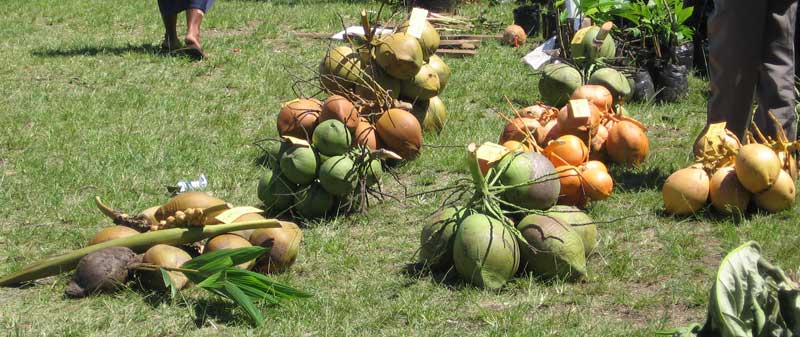 The green husks indicate nice young coconuts. At this stage the white flesh inside is still quite tender and relatively thin. It's quite tasty, although the main culinary use of coconuts this young is for drinking. You can buy a niu, or drinking coconut, almost anywhere in Samoa. Take a machete to a chilled, husked coconut and chip away a small hole and drop a straw in it. Simple as that.
As coconuts age, the white flesh thickens and the juice turns somewhat bitter (and the husk yellows and browns as evidenced in the picture). Most Samoan cooking makes use of these older coconuts, and primarily for the production of coconut cream. Coconut cream is very prevalent in Samoan cooking. Yams are commonly baked in coconut cream; skin and chop some yams and wrap them in aluminium foil, making sure a good splodge of coconut cream goes in with them. Throw them in a relatively hot oven (~200° C) for about 45 minutes to an hour. Serve them as is and sprinkle a little salt over them to give them a bit of bite. Makes for a great snack. We tend to have this at work once or twice a week for morning tea.
There are two other notable uses of coconut cream in Samoan cooking. There's palusami, which a few of us made a little while ago and there's oka. Oka is the Samoan version of a dish that exists the world over. You'd probably know it as ceviche; raw seafood "cooked" in a marinate with a strong citrus base. Samoan oka typically has coconut cream, lime juice, diced onion and cucumber and maybe some diced tomato as well. The raw seafood is almost always tuna. Oka is wonderful stuff.
If you're going to make oka (and you should at least once) you really need to make your own coconut cream. There are lots of different ways of making coconut cream but the one I've chosen is one from a Samoan source (but I haven't tried it myself, google an alternative if you're worried).
Coconut cream
- Scrape the flesh from five coconuts into a baking tin.
- Bake in the oven until the flesh browns. Don't make the oven too hot.
- Add about a cup of water and squeeze through a cheesecloth.
- Discard the flesh, the rest is your cream.
You will need
4 pounds (just under 2kg) of raw fish (preferrably yellowfin tuna)
4–5 limes
4 tomatoes, diced
2 cucumbers, diced
1 small onion, diced
5–6 small chillis, diced (optional but don't be a wuss)
Coconut cream (just over half of what the above recipe should yield)
- Cut fish into bite-sized chunks and place in a mixing bowl.
- Squeeze limes to make juice, and pour the juice onto the fish — just enough to soak all of the fish chunks.
- Marinate for at least 4 hours, preferably overnight in the refrigerator.
- Add diced vegetables and coconut cream, stir, and serve.
Monday, May 15, 2006
Samoan food - Bananas
Bananas are one of the staple crops of many nations and Samoa is no exception. Available all year round and dirt cheap, bananas are widely used for a variety of cooking purposes. As best I can tell there are typically three or four main varieties available here.
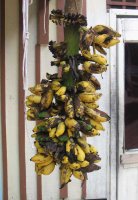
The ripe yellow banana is used as we commonly would use them in Australia, as part of fruit salads and more commonly as a general snack. You can buy them by the hand or bunch at the markets and you'll always spot bunches hanging up outside fales across the country (the picture below shows one such bunch hanging outside a beach resort on the south coast).
Despite their ubiquity these bananas are not the ones most commonly used for cooking in Samoa. Plantains are, without a doubt, the variety used most in Samoan cooking. They are typically cooked in an umu oven right alongside taro and breadfruit and served as a starchy accompaniment to the main dish(es). They're not just reserved for traditional Samoan meals however. Order some Chinese food at the foodcourt in town and they'll be an option. Ever tried Egg Foo Yong and plantain? How about sweet & sour pork? The few curry houses in Apia (invariably run by Fijian Indians and always tasty) offer plantains with their curries as well. Great stuff.
The most curious variety of banana I've come across here would have to be this one:
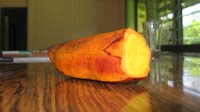
It's big; closer in size to a smallish cucumber than the bananas we're used to in Australia. I've seen two types of these ones. One is the standard yellow colour we expect of bananas. The other is orange, peel and flesh both (like the one above). The texture is quite mealy and it's not as sweet as the ripe yellow ones.
Bananas and plantains constitute a major staple food crop for millions of people in developing countries like Samoa. Cooking bananas are very similar to potatoes in how they are used. Both can be fried, boiled, baked or chipped and have similar taste and texture when served. Nutritionally one green cooking banana has about the same nutritional and calorie content as one potato. Potatoes don't grow very well here so the nutritional importance of the plantain in particular is significant.
How would I cook with the bananas here? I've used the ripe yellow bananas for desserts on several occasions. Cut a strip in the peel, load them up with crumbled chocolate, put the peel back and wrap it in foil and whack it in a moderate oven. Very nice indeed. Fruit salads of course, chopped up on cereal. The usual suspects I guess.
I haven't really played around with the plantains much but they're typically baked or chipped here. Something I'd try is frying them (which is popular in Central American cuisine). For four people, pick two ripe plantains (they turn yellow then black as they ripen) and cut them in quarters lengthwise. Fry them in relatively hot oil (not olive oil) for about five minutes or so each side. Drain on paper towel and eat straight away. You want the ripe ones so the sugar caramelises as they cook.

The ripe yellow banana is used as we commonly would use them in Australia, as part of fruit salads and more commonly as a general snack. You can buy them by the hand or bunch at the markets and you'll always spot bunches hanging up outside fales across the country (the picture below shows one such bunch hanging outside a beach resort on the south coast).
Despite their ubiquity these bananas are not the ones most commonly used for cooking in Samoa. Plantains are, without a doubt, the variety used most in Samoan cooking. They are typically cooked in an umu oven right alongside taro and breadfruit and served as a starchy accompaniment to the main dish(es). They're not just reserved for traditional Samoan meals however. Order some Chinese food at the foodcourt in town and they'll be an option. Ever tried Egg Foo Yong and plantain? How about sweet & sour pork? The few curry houses in Apia (invariably run by Fijian Indians and always tasty) offer plantains with their curries as well. Great stuff.
The most curious variety of banana I've come across here would have to be this one:

It's big; closer in size to a smallish cucumber than the bananas we're used to in Australia. I've seen two types of these ones. One is the standard yellow colour we expect of bananas. The other is orange, peel and flesh both (like the one above). The texture is quite mealy and it's not as sweet as the ripe yellow ones.
Bananas and plantains constitute a major staple food crop for millions of people in developing countries like Samoa. Cooking bananas are very similar to potatoes in how they are used. Both can be fried, boiled, baked or chipped and have similar taste and texture when served. Nutritionally one green cooking banana has about the same nutritional and calorie content as one potato. Potatoes don't grow very well here so the nutritional importance of the plantain in particular is significant.
How would I cook with the bananas here? I've used the ripe yellow bananas for desserts on several occasions. Cut a strip in the peel, load them up with crumbled chocolate, put the peel back and wrap it in foil and whack it in a moderate oven. Very nice indeed. Fruit salads of course, chopped up on cereal. The usual suspects I guess.
I haven't really played around with the plantains much but they're typically baked or chipped here. Something I'd try is frying them (which is popular in Central American cuisine). For four people, pick two ripe plantains (they turn yellow then black as they ripen) and cut them in quarters lengthwise. Fry them in relatively hot oil (not olive oil) for about five minutes or so each side. Drain on paper towel and eat straight away. You want the ripe ones so the sugar caramelises as they cook.
Saturday, May 13, 2006
Another hard day at the office
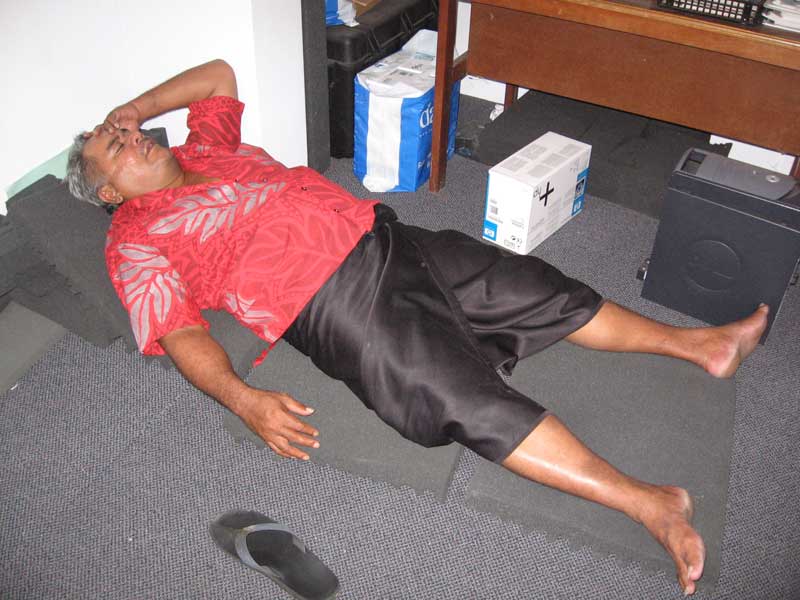
Samoa Immigration staff work a pretty gruelling schedule. With international flights arriving and departing at all hours of the day, it's essential that there is a twenty-four hour presence at the airport. The vast majority of the larger flights (737s from Australia, Fiji and New Zealand) arrive in the middle of the night, so Immigration has a couple of drivers who take staff to and from the airport as required. The consequence of which is that they're almost always bone tired.
Pictured here is one of the drivers, nicknamed "Schumaker", taking a well earned nap in one of the quieter offices in the building. Although, with his hand resting on his head like that it seems that even sleep can't provide respite from the weight of worldly troubles.
Man vs Beast - Round Two

The war rages on. But I've struck another successful blow against the filthy home-invading, rice-eating hordes of vermin that have descended upon my house. Whilst making breakfast this morning I, unintentionally, scared a rat under my oven. Seeing the opportunity this presented, I quickly went on to the offensive and set my trap. After which I casually resumed making my breakfast (being careful not to step on the trap).
Some forty minutes later there was an enormous "SNAP!" which drew me to the kitchen, whereupon I discovered my latest victim. Serves the little bugger right. I feel like I now have the upper hand. My strategy is a proven winner so all I have to do is wait for the next home invader to try its luck.
Note: I really do want to spend more time posting about other things but with my leg prohibiting more "normal" activities such as swimming, snorkeling, exercise, etc., I'm clutching at straws. Do people want to see photos of recently deceased rats on a website? I don't think so. The next post will be about something else. Promise.
Wednesday, May 10, 2006
Man vs Beast
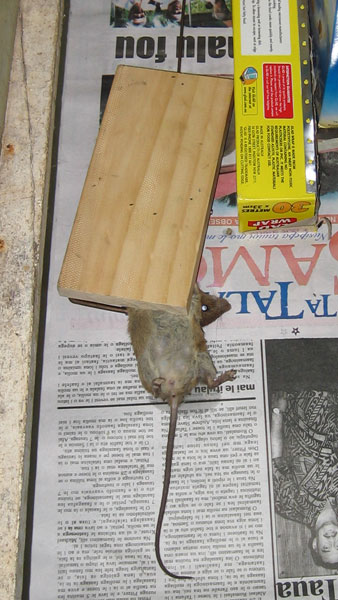
I'm all for the sanctity of life on the planet and was a big fan of All Creatures Great And Small when I was growing up, but there comes a time when you have to draw a line in the sand. For me that time was a couple of weeks ago. One morning I opened one of my kitchen cupboards to discover that a rat had eaten most of the organic arborio rice I had received as a gift from Australia. That was just taking things a little too far. James Herriot be damned, this called for revenge!
Today, after a couple of failed attempts, I achieved victory! I arrived home to discover that I caught one of the little foul rice-eating buggers in my trap. My secret: the sacrifice of a small slice of good quality Romano cheese (these are obviously rats with taste, they went for the organic rice after all).
In spite of my victory it seems the rest of the population have decided to crank things up a notch or two. I've just been out to dinner and returned home to find a significant amount of rat poo around the kitchen. I may have won the battle but it seems the war rages on.
Monday, May 08, 2006
Views from the bus
Most mornings I catch the bus into work. It's a lovely trip into town as the bus drives along a section of the eastern coastal road. This morning I had my camera in my bag and decided to take a couple of photos along the way. It's a beautiful day here; the sun is shining and the clouds, whilst present, don't really seem threatening at this stage.
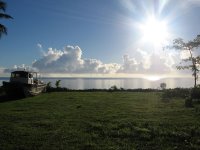
Along the coast road you'll often come across villagers' boats resting up on the foreshore like this one here in the village of Moata'a. Smaller outrigger canoes are another frequent sight, though quite often they're left floating tied to a large pole in the water instead of dragged ashore.
Another type of boat seen in the water more than on land, is the large fautasi. The fautasi is the Polynesian (I'm certain it's not just Samoan) version of the dragon boats found in China (and elsewhere). They hold crews of roughly forty to fifty people and are extremely heavy. When a team starts its regular practice for an upcoming race (such as the recent Flag Day celebrations in American Samoa or next month's Independence celebrations here) they leave the boat on the water.

Along the coast road you'll often come across villagers' boats resting up on the foreshore like this one here in the village of Moata'a. Smaller outrigger canoes are another frequent sight, though quite often they're left floating tied to a large pole in the water instead of dragged ashore.
Another type of boat seen in the water more than on land, is the large fautasi. The fautasi is the Polynesian (I'm certain it's not just Samoan) version of the dragon boats found in China (and elsewhere). They hold crews of roughly forty to fifty people and are extremely heavy. When a team starts its regular practice for an upcoming race (such as the recent Flag Day celebrations in American Samoa or next month's Independence celebrations here) they leave the boat on the water.

Friday, May 05, 2006
Manono's mobile tower now increasingly mobile

About a month or so ago I wrote a couple of posts about the beautiful island of Manono. In one of them I mentioned the mobile phone tower that sits atop the ancient star mound on Mt. Tulimanuiva and the controversy within the community (and elsewhere) its installation caused.
Today's Observer has a report stating that the 30m (not 50m as I guessed wildly last time) tower will be moved. SamoaTel's acting CEO Colm O'Donovan has confirmed that they are in negotiations with a contractor to have the tower removed from its present location. Apparently they have found a new site elsewhere on Manono that meets all relevant parties' criteria.
This is great news. The star mounds of Samoa are some of the oldest human monuments in Polynesia. They have proven invaluable to archaeologists and historians in tracing the spread of human habitation across the region and are of enormous cultural significance to all Samoans. I can only hope that SamoaTel not only removes the tower and attendant equipment shed but also helps restore the site to the condition it deserves.
On the other hand, climbing the tower does afford a rather spectacular view. I might need to head back over there and climb it one last time. ;)
Thursday, May 04, 2006
All wrapped up
The most annoying thing about bandages is that the moment you put them on, everything they cover becomes incredibly itchy. Given good bandages are sterile things and tend to breathe very well, I'm certain it's largely psychological rather than physiological.
One small part of my tattoo continues to play up and refuse to heal well. Sure, thanks to local conditions and no doubt my inadequate aftercare, it became infected, but it's not all my fault is it? Anyway, I've received (finally) some sound medical advice which sees me wrapping gauze around the wound until the "exudate" (read: "gunk and puss") disappears and taking a second course of antibiotics. Sadly, the wound looks quite deep. I only hope it doesn't leave a significant scar that would mar an otherwise great tattoo (well, in my opinion anyway).
One small part of my tattoo continues to play up and refuse to heal well. Sure, thanks to local conditions and no doubt my inadequate aftercare, it became infected, but it's not all my fault is it? Anyway, I've received (finally) some sound medical advice which sees me wrapping gauze around the wound until the "exudate" (read: "gunk and puss") disappears and taking a second course of antibiotics. Sadly, the wound looks quite deep. I only hope it doesn't leave a significant scar that would mar an otherwise great tattoo (well, in my opinion anyway).
Did the earth move for you too?
Yesterday morning I was awake or awoke, at 4.30 and felt myself shaking. I thought this was a bit weird (and annoying because that's a bad kind of sick), but then I noticed that the bed was creaking, and as the seconds passed, that the windows and whole house was making a fair bit of noise. All the dogs in the neighbourhood went dead quiet but the insects kept singing their symphony. Earthquake!
The quake lasted a while - easily three minutes - and picked up intensity about halfway through. With the epicentre in Tongan waters there really was never any danger of the quake itself manifesting dangerously here in Samoa. Furthermore, with Apia on the other side of 'Upolu, the chances of any tsunami from the region of Tonga actually causing any real grief here were close to nil.
Whilst I lay in my bed shaking and shuddering about it struck me that it felt just like those massage beds or chairs. The ones where you put in a dollar and it vibrates for a few minutes (no, not those other "massage beds"). Funny, the thoughts that run through your head.
Moments after the quake finished all the dogs in the area went beserk for a couple of minutes before settling back down to sleep. I slowly joined them in slumber for another couple of hours then woke up and made my way into work.
Once I made it into work I discovered that the Prime Minister declared all schools and government offices closed for the day in response to a tsunami alert issued earlier in the morning by the Pacific Tsunami Warning Centre (in Hawaii). I spent the morning shopping and enjoying good coffee at a nearby cafe. Two hours later his decision regarding government offices was reversed and we went back to work.
Even though yesterday's earthquake generated only the smallest of tsunamis (Niue measured a 0.21 metre wave), the threat of serious damage in Samoa is very real. Most villages in Samoa are coastal and in Apia itself, many of the emergency response arms of government have their main offices metres from the shore. The meteorology, government radio, police and fire station offices are all exposed in this way.
Another important issue here is education. Given the responses in today's Observer newspaper about the tsunami alert (Street Talk - "How about the tsunami alert?"), it's clear that many Samoans have little understanding of the nature of the event:
"I think that the warning came at the wrong time and that they (Meteorology Division) should have warned the public before the earthquake hit."
"I think that they should have warned us the night before instead of early this morning when they were expecting a tidal wave to hit our shores."
"This is a negative sign which is an indication that the Meteorological office were not doing their job."
"The sudden warning was not very professional because it was a sign that the public have no one to trust if a natural disaster hits."
Questions are already being asked about the capacity of the government to respond in a timely and appropriate fashion to natural disasters. I imagine we'll see that issue thrashed out in the newspaper over the next couple of days. I wonder though, given the responses above, if we'll see the same kind of attention paid to the importance of public education as part of any natural disaster plan.
The quake lasted a while - easily three minutes - and picked up intensity about halfway through. With the epicentre in Tongan waters there really was never any danger of the quake itself manifesting dangerously here in Samoa. Furthermore, with Apia on the other side of 'Upolu, the chances of any tsunami from the region of Tonga actually causing any real grief here were close to nil.
Whilst I lay in my bed shaking and shuddering about it struck me that it felt just like those massage beds or chairs. The ones where you put in a dollar and it vibrates for a few minutes (no, not those other "massage beds"). Funny, the thoughts that run through your head.
Moments after the quake finished all the dogs in the area went beserk for a couple of minutes before settling back down to sleep. I slowly joined them in slumber for another couple of hours then woke up and made my way into work.
Once I made it into work I discovered that the Prime Minister declared all schools and government offices closed for the day in response to a tsunami alert issued earlier in the morning by the Pacific Tsunami Warning Centre (in Hawaii). I spent the morning shopping and enjoying good coffee at a nearby cafe. Two hours later his decision regarding government offices was reversed and we went back to work.
Even though yesterday's earthquake generated only the smallest of tsunamis (Niue measured a 0.21 metre wave), the threat of serious damage in Samoa is very real. Most villages in Samoa are coastal and in Apia itself, many of the emergency response arms of government have their main offices metres from the shore. The meteorology, government radio, police and fire station offices are all exposed in this way.
Another important issue here is education. Given the responses in today's Observer newspaper about the tsunami alert (Street Talk - "How about the tsunami alert?"), it's clear that many Samoans have little understanding of the nature of the event:
"I think that the warning came at the wrong time and that they (Meteorology Division) should have warned the public before the earthquake hit."
"I think that they should have warned us the night before instead of early this morning when they were expecting a tidal wave to hit our shores."
"This is a negative sign which is an indication that the Meteorological office were not doing their job."
"The sudden warning was not very professional because it was a sign that the public have no one to trust if a natural disaster hits."
Questions are already being asked about the capacity of the government to respond in a timely and appropriate fashion to natural disasters. I imagine we'll see that issue thrashed out in the newspaper over the next couple of days. I wonder though, given the responses above, if we'll see the same kind of attention paid to the importance of public education as part of any natural disaster plan.
Tuesday, May 02, 2006
Business House sports
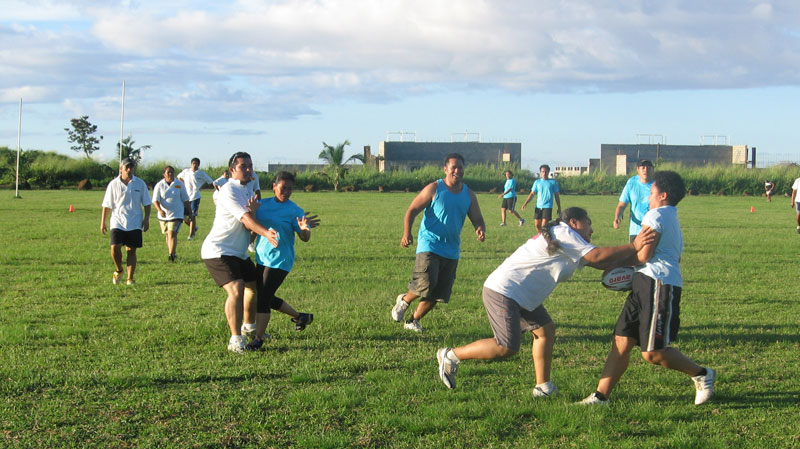
Every year a range of social sports competitions are held in
The first competition this year is seven-a-side touch footy. The Ministry of Prime Minister & Cabinet has fielded a team, comprised mostly of Immigration staff. We had our first game last week which saw us up against the Ministry of Foreign Affairs team. Sadly, with three or four of their players members of a touch footy team that plays in the regular "professional" competition, we were somewhat outclassed and lost the match. Yesterday's match against the TradePac team was a different story however, with our team notching up a win, four tries to three.
Sadly, I've had to restrict my participation to being the photographer and water boy. As my tattoo is still in the process of healing, I can't get out there and have a run around, which I find very frustrating. Hopefully I'll be able to start playing from next week. With the competition's pool round only lasting six weeks, I'm loathe to miss too many more matches.
The picture shows one of the Immigration officers, Vaileta, rather vigorously "touching" the ball carrier in last's weeks match against Foreign Affairs. This was as close to a big hit as we came during the match.
Wednesday, April 26, 2006
Samoan Tattooing
The art of tattooing has long existed in

Deciding to have the pe'a is a mammoth undertaking by any individual. Something in the order of 60-65% of the body is tattooed over as short a period of time as the recipient can handle (six or seven days’ work over a span of about two weeks is typical). After the tattoo is finished there follows a long period of recuperation; six months to a year is a normal kind of time frame. More often than not people are unable to work for much of this time to let their body rest. Because of this, the significant upfront cost and the social implications, any person wishing to have the pe'a must first seek permission from all their family.
A week ago my friends and I visited Su'a Petelo Suluape in the
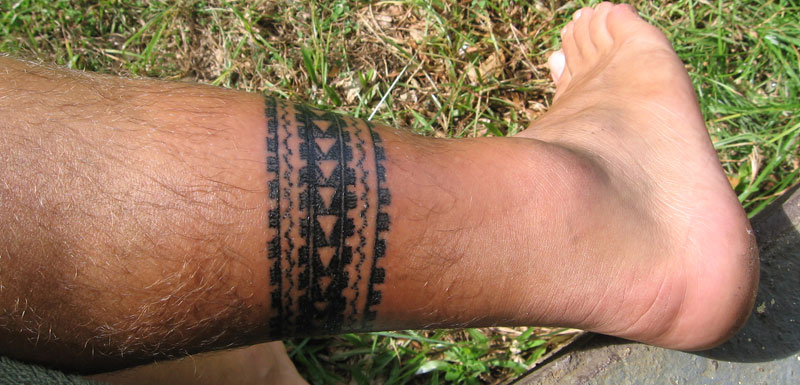
Whilst not there for the pe'a, two of us did have Suluape tattoo our legs in the traditional Samoan fashion. The only creative control we had over the process was in determining how big the tattoo should be (ie. we shaved as much, or as little, hair off our legs to provide the "canvas"). The rest was in Suluape's hands.

Suluape uses the traditional implements and techniques to do his work. He uses a mallet to strike a variety of combs with extremely sharp teeth to push the ink into the skin. The mallet is known as the sausau and the combs have different names. The autapulu is a wide comb used to fill in large dark areas of the tattoo. The ausogi'aso tele is used for making thick lines, the ausogi'aso laititi for thin lines. The aumogo is a small comb used for making a variety of small marks. For our tattoos, Suluape did not need the autapulu (thank goodness!). Suluape's combs seemed to be fashioned from some kind of glass or plastic. Traditionally the combs were carved from a boar's tusk.
Did it hurt? Oh yes. It took about one hour for the work to be completed and it was an hour spent grinding teeth, clenching fists and practicing lots of meditative breathing techniques. It was particularly painful when Suluape was working on the skin directly above my shin bone. I’m extremely happy with the result however and consider it to be well worth the pain (although what we experienced is clearly nothing compared to what the man having the pe’a must be feeling).
The history and art of Samoan tattoo is fascinating and I’ve barely scratched the surface of the topic. The process of having the pe’a is highly complex, full of taboos, customs and demands on the tattooist, recipient and the recipient’s family. It’s well worth another post, which I’ll try and get around to soon, but in the meantime, if you’re interested, I suggest reading this introduction to the pe’a and traditional Samoan tattooing.
The first photo is taken from last year's Samoan Tourism Authority calendar. It's a great example of the pe'a. The second shows Suluape striking the aumogo with the sausau to create small lines of my friend's tattoo. The third image shows my (swollen) leg the morning after having it done. Since then my leg and foot have swollen up well beyond normal size and I've had a small amount of infection to deal with. As of today though, the swelling is almost entirely gone and the course of antibiotics I'm taking is having its effect in dealing with the infection.Tuesday, April 25, 2006
Life is short. PRAY HARD.
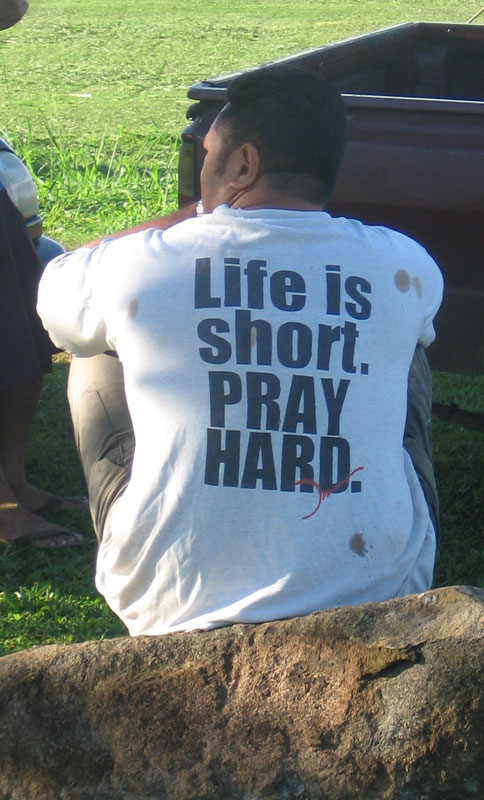
I spotted this t-shirt whilst at the first match of touch football of the season for the inter-Ministry sports teams. It's by no means the only religious t-shirt I've noticed since I've been in Samoa, but I like it. The other one I like has "No weapon formed against me shall prosper. (Isiah 54:17)" on the front, with "God's got my back" written on the back. All in big bold bright yellow lettering on a black t-shirt.
Saturday, April 22, 2006
Just another day at the office
Yesterday (Friday) was my first day back at work after a couple of weeks off. My timing could not have been better. A relatively straightforward working day was followed by two work-related social functions that were great.
First, we joined Prime Minister Tuilaepa and Ministry of Prime Minister & Cabinet CEO Poloma Komiti on the roof of the government building to celebrate the PM's recent re-election victory (which warrants a post of its own). The government building is the tallest in Samoa and the view of Apia and the surrounding villages is unbelievable. Pictured here is the view towards Mt. Vaea with the Catholic cathedral in the foreground. Smoke from a few fires can be seen floating upwards in the background.
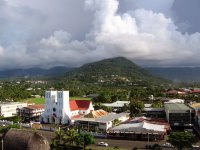
As the sun set the colour of the sky and clouds changed dramatically, and the number of fires burning in and around Apia increased dramatically. The fires were most likely coming from umu ovens, as families prepared their evening meals.
The PM gave a small, lighthearted speech and everyone had a good time, enjoying some food and drink. I was most delighted however, when Tuilaepa whipped out his ukelele and entertained the assembled with some favourite Samoan tunes. The head of the Press Secretariat accompanied the PM on the guitar and many others sang along. Who knew that the PM likes to rock out on the uke!
After this function reached its conclusion, I joined a small number of Immigration staff in attending a dinner at the Chinese embassy. With a considerable economic, aid and development presence in Samoa, the Chinese are always working with Samoan Immigration in obtaining the relevant entry permits for the various Chinese nationals who come to Samoa. With some new diplomatic staff recently arrived in Samoa, and the new Chinese ambassador due in under two weeks, it was a good opportunity for everyone to get to know each other a little better.
The meal we had was great. We enjoyed a selection of Chinese style dishes, some of which featured a degree of local flavour. Chicken and breadfruit stir fried in ginger, huge crabs wok fried with ginger and spring onions, steamed whole fish and amazingly good tuna sashimi were just some of the highlights. They also had a bean curd dish, which I was most interested in as finding tofu in Samoa can be a challenge. It transpires that their chef imports the yellow beans from China and makes his own bean curd. After dinner our hosts turned on their Karaoke machine and we all sang a few songs to conclude the night.
For a first day back at work, it was a good one. Just another day at the office? I certainly hope so.
First, we joined Prime Minister Tuilaepa and Ministry of Prime Minister & Cabinet CEO Poloma Komiti on the roof of the government building to celebrate the PM's recent re-election victory (which warrants a post of its own). The government building is the tallest in Samoa and the view of Apia and the surrounding villages is unbelievable. Pictured here is the view towards Mt. Vaea with the Catholic cathedral in the foreground. Smoke from a few fires can be seen floating upwards in the background.

As the sun set the colour of the sky and clouds changed dramatically, and the number of fires burning in and around Apia increased dramatically. The fires were most likely coming from umu ovens, as families prepared their evening meals.
The PM gave a small, lighthearted speech and everyone had a good time, enjoying some food and drink. I was most delighted however, when Tuilaepa whipped out his ukelele and entertained the assembled with some favourite Samoan tunes. The head of the Press Secretariat accompanied the PM on the guitar and many others sang along. Who knew that the PM likes to rock out on the uke!
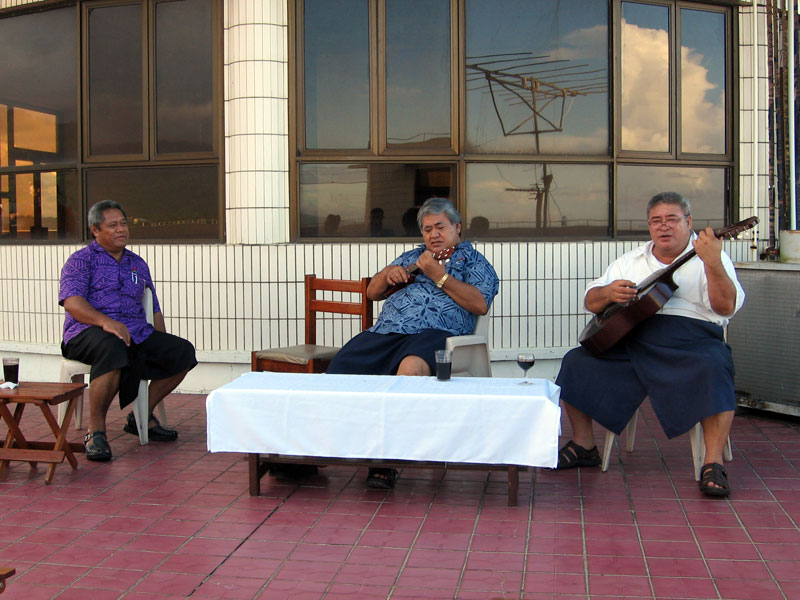
After this function reached its conclusion, I joined a small number of Immigration staff in attending a dinner at the Chinese embassy. With a considerable economic, aid and development presence in Samoa, the Chinese are always working with Samoan Immigration in obtaining the relevant entry permits for the various Chinese nationals who come to Samoa. With some new diplomatic staff recently arrived in Samoa, and the new Chinese ambassador due in under two weeks, it was a good opportunity for everyone to get to know each other a little better.
The meal we had was great. We enjoyed a selection of Chinese style dishes, some of which featured a degree of local flavour. Chicken and breadfruit stir fried in ginger, huge crabs wok fried with ginger and spring onions, steamed whole fish and amazingly good tuna sashimi were just some of the highlights. They also had a bean curd dish, which I was most interested in as finding tofu in Samoa can be a challenge. It transpires that their chef imports the yellow beans from China and makes his own bean curd. After dinner our hosts turned on their Karaoke machine and we all sang a few songs to conclude the night.
For a first day back at work, it was a good one. Just another day at the office? I certainly hope so.
Saturday, April 15, 2006
Piula Cave Pool
About thirty minutes east of Apia, along the coastal road, is the Piula Theological College. The college was established by the Methodist Church in 1868. Piula is a transliteration of "Beulah", meaning married.
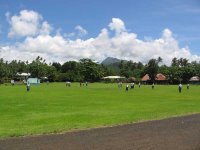
The college sits on beautiful grounds. There is a large oval which is used for games of kirikiti and the real draw card of Piula is the cave pool which is found directly underneath the foundations of the main church on the grounds.
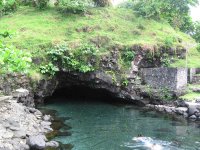
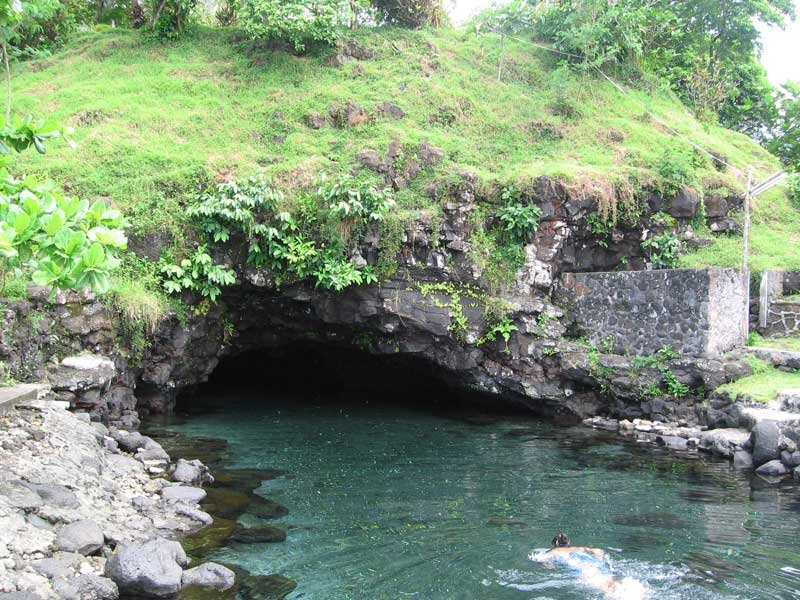
A large freshwater pool is separated from the ocean by a wall of black volcanic rock. The water is cold and clean and the pool is inhabited by many small fish. At the rear of the pool, one can dive underwater and see light filtering through the wall. A small, three metre long opening connects the pool to a second, smaller pool. It might seem a little daunting at first, but it's an easy swim.
The college sits on beautiful grounds. There is a large oval which is used for games of kirikiti and the real draw card of Piula is the cave pool which is found directly underneath the foundations of the main church on the grounds.

A large freshwater pool is separated from the ocean by a wall of black volcanic rock. The water is cold and clean and the pool is inhabited by many small fish. At the rear of the pool, one can dive underwater and see light filtering through the wall. A small, three metre long opening connects the pool to a second, smaller pool. It might seem a little daunting at first, but it's an easy swim.
Subscribe to:
Posts (Atom)